Amber enrol buttons are DataCamp and Udemy affiliate links; we earn a commission if you enrol through them. How we're funded.
Quick answer
For most finance and accounting professionals, the fastest useful start is Gen AI & AI Agents for Finance, Accounting & Administration on Udemy: bought once, under three hours, with a confidentiality rule for client data. On a subscription, DataCamp’s AI for Finance covers the same ground in Microsoft Copilot with graded exercises. Firms that run on Microsoft should add Azure AI Fundamentals, whose exam is now AI-901 (it replaced AI-900 on 30 June 2026 and expects basic Python syntax); for a no-code proctored credential, take the AWS AI Practitioner. Those exams are assessed; course certificates record completion.
AI-102 is retired. The replacement is Microsoft Certified: Azure AI Apps and Agents Developer Associate (AI-103).
Exam AI-900: Microsoft Azure AI Fundamentals is retired. The replacement is Exam AI-901: Microsoft Azure AI Fundamentals, which earns the same Azure AI Fundamentals certification but expects Python and familiarity with REST APIs and SDKs.
Where we would start on DataCamp or Udemy
We choose these picks only among our affiliate partners’ courses (365 Data Science, DataCamp and Udemy). Our full ranking also includes courses that earn us nothing.
Three hours, written for finance specifically rather than adapted to it. It is the only thing in our catalogue aimed at this page's audience by name, and short enough to take before committing to anything longer.
Why this course, and its limitations
A focused introduction to prompting and workflow design for finance using Microsoft Copilot. We value that audience fit. Its scope is narrow, and the recorded prerequisite is Introduction to ChatGPT; it should not be treated as a finance qualification.
Learning: 4.2/5. Credential: 2.8/5. These are separate editorial judgments, not learner ratings or job-placement statistics.
What generative AI gets right and wrong in finance work, a confidentiality rule before any client data goes near a tool, document capture from invoices and statements, spreadsheets and agents, with a thirty-day plan; rated 4.3 by 49 learners, updated August 2026.
Why this course, and its limitations
A no-code course, bought once, on generative AI in finance, accounting and administration: where it helps and fails, a confidentiality rule before client data reaches a tool, turning invoices and statements into data, spreadsheets, agents and a thirty-day plan. We value that grounding in everyday finance tasks. It is an introduction, not a finance qualification. The certificate is an unassessed completion record.
Learning: 3.8/5. Credential: 1.5/5. These are separate editorial judgments, not learner ratings or job-placement statistics.
The table below compares 8 certifications on provider, level, realistic time, coding needed and best for.
| Certification | Provider | Level | Realistic time | Coding needed | Best for | Enrol |
|---|---|---|---|---|---|---|
| Gen AI & AI Agents for Finance, Accounting & Administration | Udemy | Beginner | ~2.6 hours | No | Accounting and admin staff | Udemy → |
| AI for Finance | DataCamp | Beginner | ~3 hours | No | Finance teams on Copilot | DataCamp → |
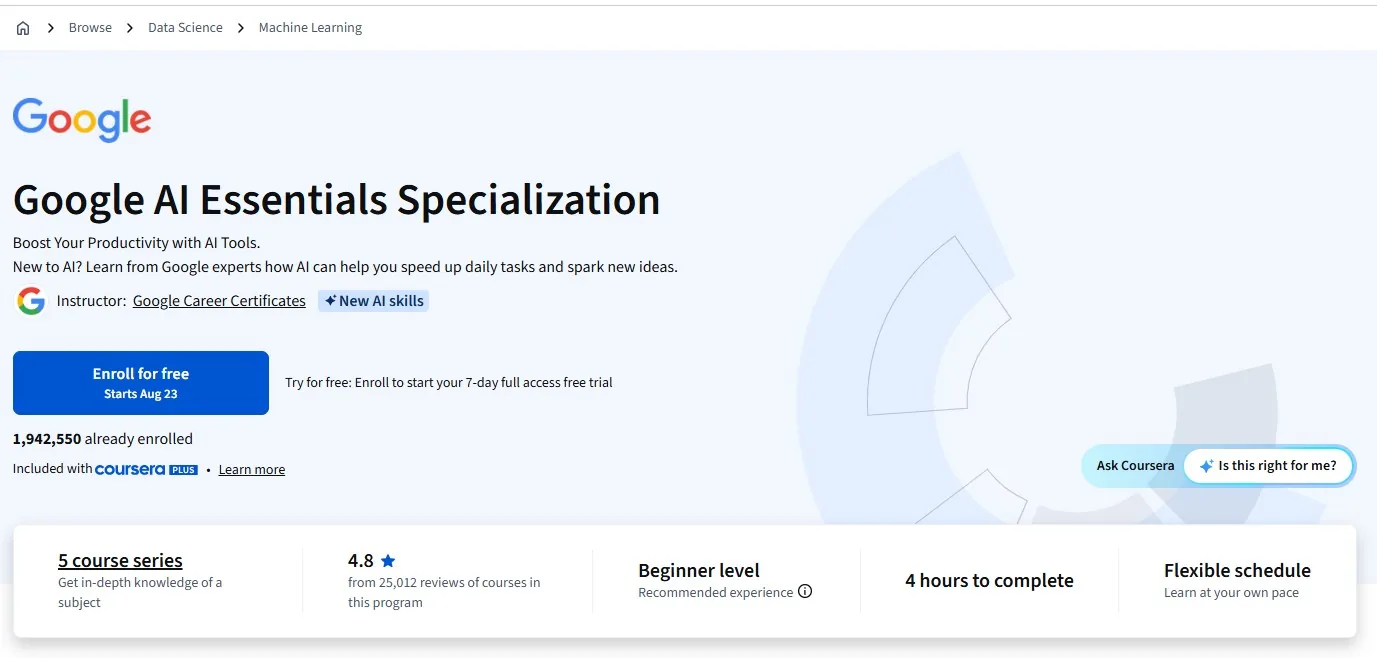
| Google AI Essentials | Google (Coursera) | Beginner | ~6–10 hours | No | Most finance and accounting roles | Coursera → |
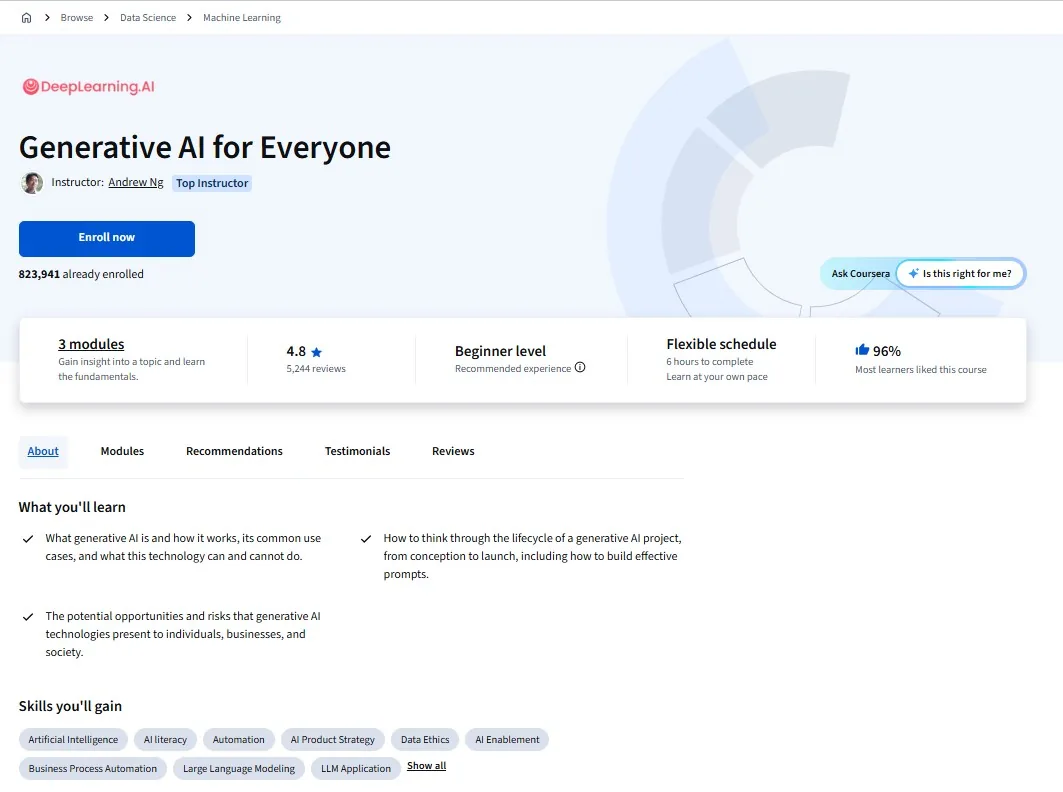
| Generative AI for Everyone | DeepLearning.AI (Coursera) | Beginner | ~6 hours | No | Understanding genAI limits before relying on it | Coursera → |
| Azure AI Fundamentals (now exam AI-901) | Microsoft | Foundational | ~2–4 weeks of prep | Basic Python | Microsoft-stack firms; Copilot-era credibility | |
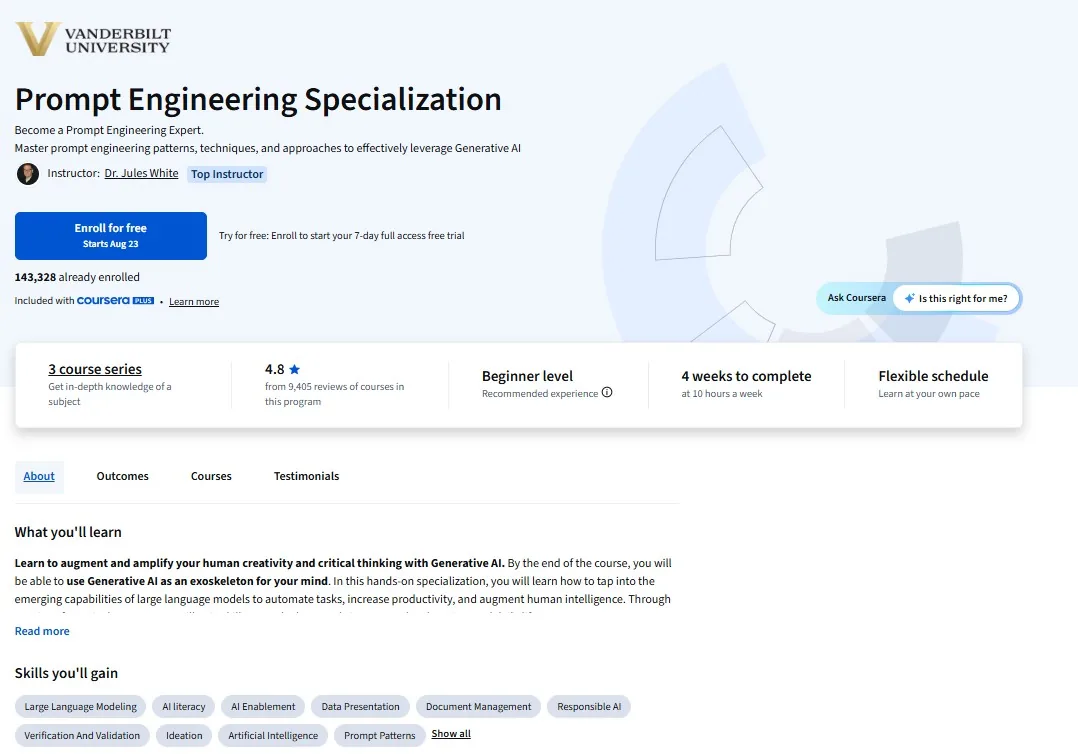
| Prompt Engineering Specialization | Vanderbilt (Coursera) | Beginner | ~39 hrs | No | Repeatable prompts for reporting and analysis | Coursera → |
| AWS Certified AI Practitioner (AIF-C01) | AWS | Foundational | ~4–6 weeks of prep | No | Finance tech teams in AWS shops | |
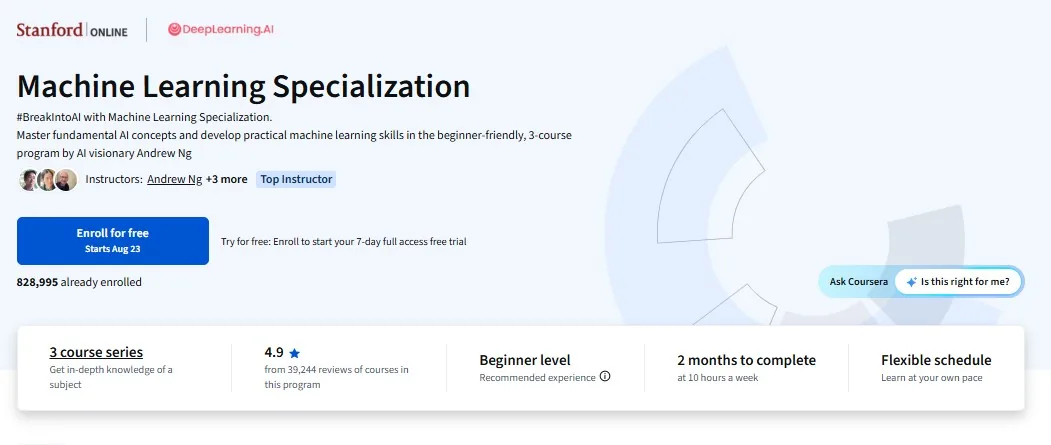
| Machine Learning Specialization | DeepLearning.AI & Stanford Online (Coursera) | Intermediate | ~95 hrs | Yes (Python) | Quants and analysts moving into modeling | Coursera → |
What's the best AI certification for accountants versus analysts?
Accountants and controllers should start with the short finance course in the Quick answer and take Google AI Essentials as the broader baseline — the wins in accounting are document-heavy (memos, reconciliations narrative, close documentation, client communication), and that's exactly the work general genAI skills accelerate. Analysts whose value is in models and forecasts should look one shelf over, at the analytics-first path.
The distinction matters because the marketing blurs it. Accounting work rewards judgment about generated text: does this technical memo actually reflect the standard, did the tool invent a citation to guidance that doesn't exist? A general certification plus your professional scepticism covers that. Analyst work increasingly rewards tooling depth — working with data at scale, automating recurring analysis, eventually modeling. That path runs through our best AI certifications for data analysts guide, and for the ambitious, toward the Machine Learning Specialization. Pick the lane that matches your actual output, not your job title — plenty of "analysts" do accountant-shaped work and vice versa.
Do you need to learn Python for AI in finance?
Most finance professionals don't. The high-frequency AI use-cases in finance and accounting — drafting, summarizing, first-pass analysis, Excel formula help — are prompting tasks, not programming tasks. A no-code certification covers them completely.
Python earns its keep in two finance situations: you're automating recurring data work beyond what Excel and Power Query handle gracefully, or you're heading toward quantitative modeling and forecasting as a specialization. Both are real, well-paid directions — but they're multi-month commitments, and starting there because a listicle said "learn Python" is how busy professionals abandon courses at week three. Sequence it: no-code certification now, visible wins at work, then the technical route via the staged plan in our AI certification roadmap if the appetite is still there.
Does AI training count toward CPA CPE requirements?
Only if the provider is registered for CPE — and most general AI courses aren't. Coursera certificates don't automatically carry NASBA-registered CPE credit, so verify before assuming. Your state board's rules govern what counts.
The good news for CPAs: accredited CPE providers and state societies have moved quickly on AI content, so if CPE is a hard constraint, check your state society's AI offerings first. The same double-duty logic applies as elsewhere: it's usually better to take the strongest course for capability and satisfy CPE through normal channels than to pick a weaker course because it comes with credit hours attached. Firms increasingly run internal AI training too — take it if offered, but note that internal training isn't a portable credential when you change employers.
Not sure this is the right one for you?
Tell the picker about your background and what you want the certificate to do, and it narrows the list to the one or two courses we would start with. It suggests only our affiliate partners’ courses, and says so before it suggests anything.
Try the AI Certification Picker →What about client confidentiality and data risk?
Same hard line as every regulated profession: no client-identifiable data in public AI chatbots — not client names, not draft financials, not deal terms. Professional confidentiality obligations and, for auditors, independence considerations don't have an "but the tool was convenient" exception. Firm policy governs; if your firm has none, push for one before an incident writes it.
What a good certification adds here is the mechanics behind the rule: understanding which tools retain and train on inputs, what an enterprise deployment with contractual data protections actually changes, and how to de-identify work product before prompting. That knowledge is precisely what separates the professional who uses AI defensibly from the one who creates the firm's first AI incident. It's also increasingly a client-facing skill — clients are asking their accountants how AI touches their engagement, and "here's our approach and its safeguards" is a much better answer than a blank look.
Which path makes sense if your firm runs on Microsoft?
Take Azure AI Fundamentals as your first vendor credential, knowing that its exam changed on 30 June 2026: AI-900 was retired, and the certification now requires AI-901, which expects basic Python syntax. Finance departments live in Excel, Teams, and increasingly Copilot — so Microsoft's foundational AI exam maps directly onto the tools your organization is deploying, and it's the vendor name your IT and leadership already trust.
AI-901 is a real proctored exam, not a course completion certificate, which changes how it reads on an internal profile: it signals you cleared an external bar. Microsoft publishes a free study guide and practice assessment for it. The technically inclined can continue to AI-103, which replaced the retired AI-102, but for most finance professionals Azure AI Fundamentals plus daily Copilot fluency is the right stopping point. That second half is the part nobody sells you a course for, because it is not a credential — it is a habit. If you want it taught rather than absorbed, DataCamp's AI for Finance is three hours built on Copilot rather than Python, aimed at exactly the drafting, summarising and first-pass analysis this page keeps pointing at, and Microsoft Copilot in Excel does the same for the spreadsheet your team actually lives in. Neither is a proctored credential and neither replaces the exam — they are the fluency half, not the signal half. If the Python in AI-901 is a step too far, or your organization runs AWS or Google Cloud instead — more common in fintech than in corporate finance — the no-code AWS AI Practitioner fills the same slot, and our AWS vs Azure vs Google comparison settles which suits your stack. Free preparation resources for all three are listed in our free AI certifications guide.
When should finance professionals skip certifications entirely?
When you're senior enough that nobody will ever screen your CV again, and the time would come out of client work or team leadership. A controller with fifteen years of experience doesn't need a beginner badge; they need two focused days building an AI-assisted close checklist their team actually uses.
The certificate is a screening-stage asset and a structured-learning device — valuable early-career and mid-career, decorative at partner level. Senior people extract more value from doing the syllabus without the badge: read the same material, build one workflow improvement, present it internally. Also skip if your firm is about to roll out structured internal AI training; take the free internal version first, then decide what's missing. The honest economics of when credentials pay are in are AI certifications worth it — the answer varies more by career stage than by industry.
How do you turn the certificate into something your firm notices?
Automate one recurring deliverable within thirty days of finishing — that's the move that makes the credential real. Strong candidates: the monthly variance commentary, the first draft of a technical memo, or the recurring board-pack narrative. Measure the hours saved and keep the before/after versions.
Then socialize it deliberately. Walk your manager through the workflow, offer it to the team as a template, and put both the credential and the use-case in your next review cycle. Finance leadership is currently under pressure to show AI progress, and a person with a recognized certificate plus one working, policy-compliant automation is an easy story for them to tell upward — which tends to convert into project assignments and visibility. What doesn't convert: a certificate sitting silently on LinkedIn while you work exactly as before. In a function as measurable as finance, demonstrated time savings are the currency; the credential is just the cover page.
Where most finance AI advice gets it wrong
It over-indexes on machine learning. Many "AI for finance" lists push accountants toward ML and predictive-modeling courses — regression, neural networks, forecasting theory. In our view that's the wrong course for at least four out of five people reading this: the near-term wins in finance are language wins, not modeling wins.
Look at where the hours actually go in a finance role: writing and reviewing documents, explaining variances, preparing memos, responding to auditors, cleaning up narratives around numbers someone else's system produced. Generative AI attacks precisely that workload — which is why a two-week genAI certification outperforms a three-month ML course for a working accountant, and why our generative AI certification picks are usually the right second step here. ML skills matter for the minority building models; for everyone else they're an expensive detour that ends with an unfinished Coursera specialization in March. The uncomfortable version: the best AI investment for most finance professionals is the least glamorous one on the list.
Verdict
Start with Gen AI & AI Agents for Finance, Accounting & Administration on Udemy — under three hours, bought once, and the only item here written around a spreadsheet and a confidentiality rule rather than around AI in the abstract. Then Azure AI Fundamentals (now exam AI-901, which expects basic Python) if your firm is a Microsoft shop, or the no-code AWS AI Practitioner if Python is a step too far; that pair covers capability and credibility for most finance and accounting careers right now. Google AI Essentials is the broader baseline if you would rather start general — with Coursera financial aid, a per-course discount, if the fee is a barrier. Analysts moving toward modeling should follow the data-analyst path instead, budgeting months rather than weeks. Both routes, and where they lead next, sit within our wider full AI certification ranking. Two minutes with the AI certification Picker will tell you which fits your situation.
Certifications featured in this guide
Every option below is one we cover in depth. Each link goes to the provider’s own page; where we’ve published a full review, read that first.
Ready to start?
Included in a DataCamp subscription rather than bought outright. DataCamp's pricing page shows the plans and the price for your country, and one subscription covers the rest of its catalogue too.
Frequently asked questions
What is the best AI certification for accountants?
Start with a short finance-specific course such as Gen AI & AI Agents for Finance, Accounting & Administration on Udemy, under three hours; then Google AI Essentials is the strongest general pick for most accountants: no coding, short enough to finish in a week or two of evenings, and aimed squarely at the document-heavy work where generative AI actually saves accounting time — technical memos, reconciliation narratives, close documentation, client correspondence. If your firm runs on Microsoft, pair it with Azure AI Fundamentals — now exam AI-901, which replaced AI-900 on 30 June 2026 and expects basic Python syntax; the AWS AI Practitioner is the no-code proctored alternative. Either is a real proctored exam rather than a course-completion certificate, which changes how it reads internally: it signals you cleared an external bar.
The pairing matters more than either credential alone. Google AI Essentials builds the capability; the proctored exam supplies the external credibility, and Microsoft’s study guide and practice assessment for AI-901 are free. If you are an analyst rather than an accountant — someone whose value sits in models and forecasts rather than in judgement about generated text — the analytics-first path fits better, and it is a months-long commitment rather than a weeks-long one.
Do accountants need to learn AI?
Working knowledge is becoming baseline rather than optional. Firms are deploying Copilot-class tools directly into everyday accounting workflows, and professional bodies have been adding AI content to their CPE catalogues. The requirement is narrower than the hype suggests, though: you do not need technical depth, you need competent and defensible use — decent prompting, disciplined verification of what comes back, and clarity about what you are allowed to put into a tool at all.
That last point is where the real professional risk sits. No client-identifiable data goes into a public AI chatbot — not client names, not draft financials, not deal terms. Confidentiality obligations, and independence considerations for auditors, have no convenience exception. What a good certification adds beyond prompting technique is the mechanics behind that rule: which tools retain and train on inputs, what an enterprise deployment with contractual data protections actually changes, and how to de-identify work product before you prompt.
Does AI certification count for CPE credit?
Usually not automatically, and this is one to verify rather than assume. Most general AI certifications are not NASBA-registered CPE providers, so they carry no credit hours by default — Coursera certificates included. Your state board’s rules govern what actually counts, and they vary, so that is the authority to check first rather than any course provider’s marketing page.
The practical advice runs the opposite way to what most people expect. Accredited CPE providers and state societies have moved quickly on AI content, so if CPE is a hard constraint, start with your state society’s own AI offerings — many now run accredited courses that satisfy the requirement directly. Otherwise it is usually better to take the strongest course for capability and satisfy CPE through your normal channels than to pick a weaker course because it happens to come with credit hours attached. Firms increasingly run internal AI training too, which is worth taking either way.
Is Python required for AI in finance?
No — and starting there is how busy professionals abandon courses at week three. The high-frequency AI use cases in finance and accounting are prompting tasks rather than programming tasks: drafting, summarising, first-pass analysis, Excel formula help. A no-code certification covers them completely, and it is the right first step for the large majority of people in the field.
Python earns its keep in two specific finance situations. The first is automating recurring data work that has outgrown what Excel and Power Query handle gracefully. The second is a deliberate move toward quantitative modelling and forecasting as a specialisation. Both are real, well-paid directions, and both are multi-month commitments rather than weekend ones — the Machine Learning Specialization is the usual route. Sequence it properly: take the no-code certification first, and add Python when you have a specific recurring task that genuinely needs it.
Which AI certification do Big 4 firms value?
None is a stated requirement, and any list claiming otherwise is guessing. The large firms run substantial internal AI training programmes of their own, and that is what their people actually complete. Externally, what travels is recognisable names — Google, Microsoft’s Azure AI Fundamentals (now exam AI-901) and DeepLearning.AI credentials all signal initiative to a reviewer who has thirty seconds. Obscure paid certificates generally do not, and a long list of them reads worse than none at all.
The more useful question is what you do after the certificate, because that is the part a firm notices. Automate one recurring deliverable within thirty days of finishing — the monthly variance commentary, the first draft of a technical memo, the recurring board-pack narrative — then measure the hours saved and keep the before-and-after versions. Finance leadership is under pressure to show AI progress, and someone holding a recognised credential plus one working, policy-compliant automation is an easy story to tell upward.
Keeping this current. Course formats, prices, and certification exam fees change and vary by region. We review our guides regularly, and we always recommend confirming the specifics on the provider's official page before you enrol.