Amber enrol buttons are DataCamp and Udemy affiliate links; we earn a commission if you enrol through them. How we're funded.
Quick answer
IBM Generative AI Engineering Professional Certificate is the most complete option here if you intend to build: it covers retrieval-augmented generation, embeddings and agents rather than chat prompting, which is what generative-AI job adverts actually name in 2026. For non-engineers, a prompt-engineering or generative-AI literacy credential gives far more usable skill per hour and needs no code at all. The nine below are ordered by our score, led by AI Engineer Core Track: LLM Engineering, RAG, QLoRA, Agents on Udemy; read the badge on each entry before the brand on it.
Where we would start on DataCamp
We choose this pick only among our affiliate partners’ courses (365 Data Science, DataCamp and Udemy). Our full ranking also includes courses that earn us nothing.
Retrieval-augmented generation, embeddings and agents are the three things this page says generative-AI adverts actually name in 2026 — and they are what this track is, in twenty-one hours against the IBM certificate's one hundred and fifty-six. It is not a replacement for that certificate if what you need is a professional credential with a recognised name on it. It is the fastest honest route to the skills behind it.
How widely generative AI is actually used. Eurostat reports that in 2025, 8.8% of EU enterprises used AI that generates written or spoken language or code — rising to 31.7% among large enterprises, where it is the second most-used AI technology after text mining. Overall enterprise AI use reached 20.0%, up 6.5 percentage points on 2024. This is EU data; the US picture will differ, but it is the clearest official adoption series available.
Compare them at a glance
All nine ranked certifications, with level, time, cost and best-fit audience. Seven come from Coursera, one from DataCamp and one from Udemy. AI Engineer Core Track: LLM Engineering, RAG, QLoRA, Agents scores highest at 4.9/5, Google AI Essentials is the shortest at about 6–10 hours, and IBM Generative AI Engineering Professional Certificate is the longest at about 188 hours.
| # | Certification | Level | Time | Cost | Best for | Rating | Enrol |
|---|---|---|---|---|---|---|---|
| 1 | AI Engineer Core Track: LLM Engineering, RAG, QLoRA, Agents | Intermediate | ~33.45 hrs | Udemy course (buy once) | Overall | 4.9 | Udemy → |
| 2 | Developing AI Applications | Intermediate | ~21 hrs | DataCamp Premium (subscription) | Building | 4.8 | DataCamp → |
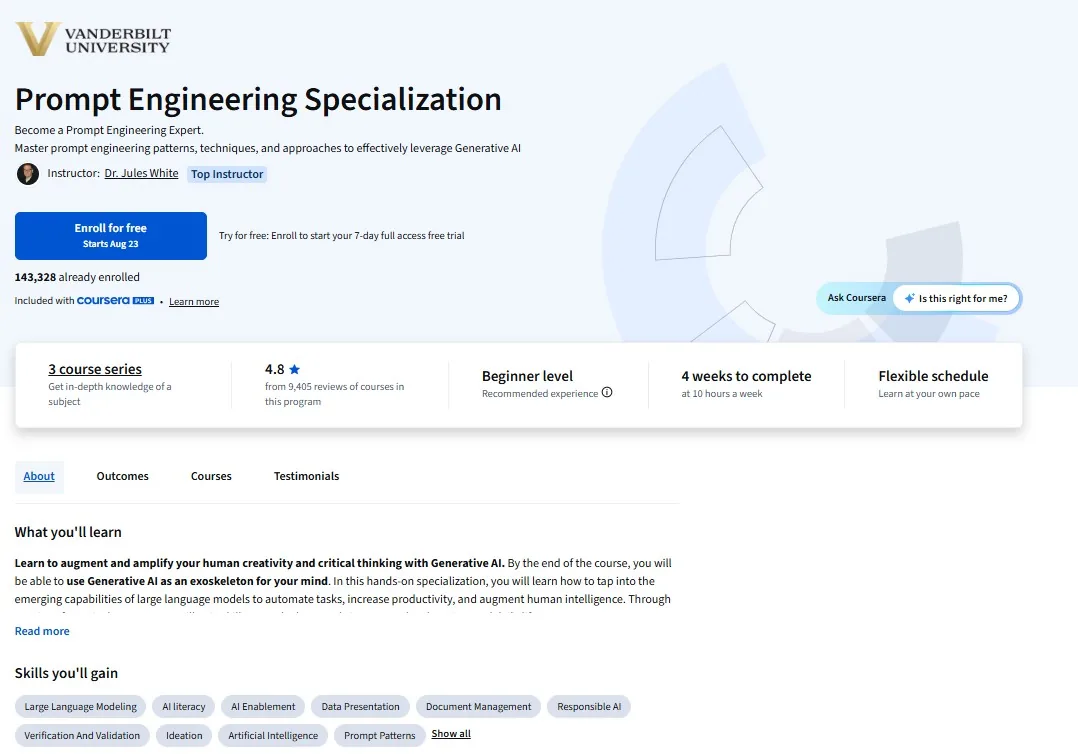
| 3 | Prompt Engineering Specialization | Beginner | ~39 hrs | Coursera (subscription or Plus) | Prompting | 4.5 | Coursera → |
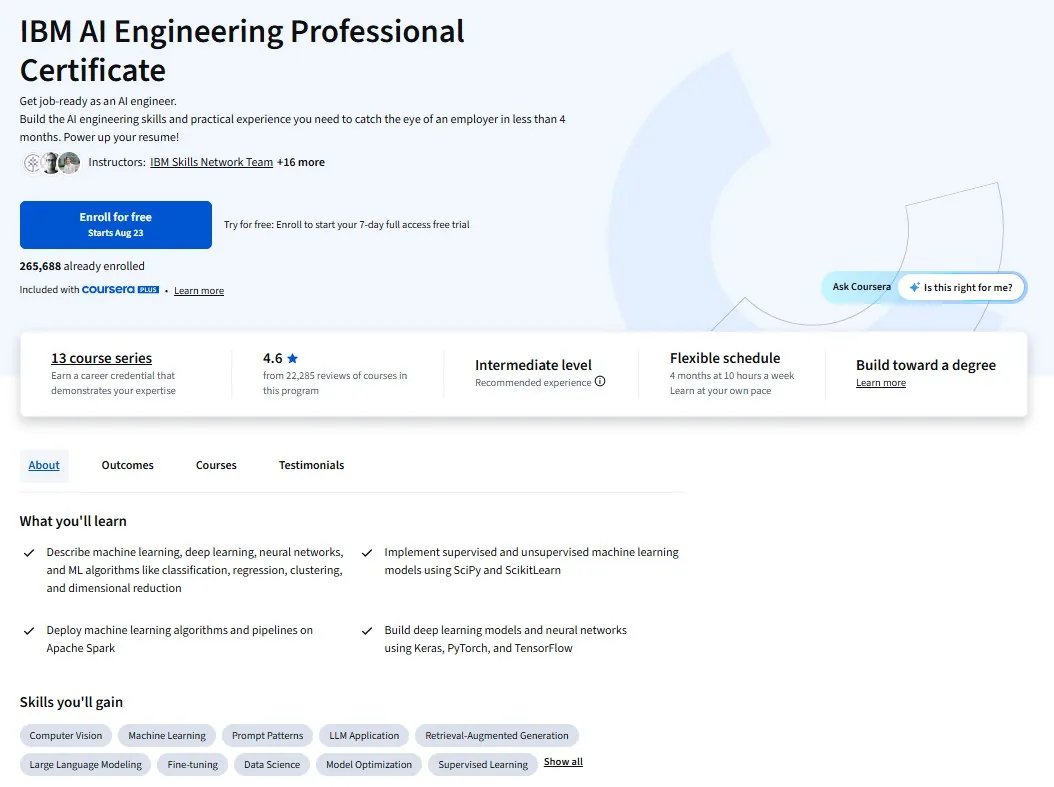
| 4 | IBM AI Engineering Professional Certificate | Intermediate | ~168 hrs | Coursera (subscription or Plus) | ML Foundation for GenAI | 4.5 | Coursera → |
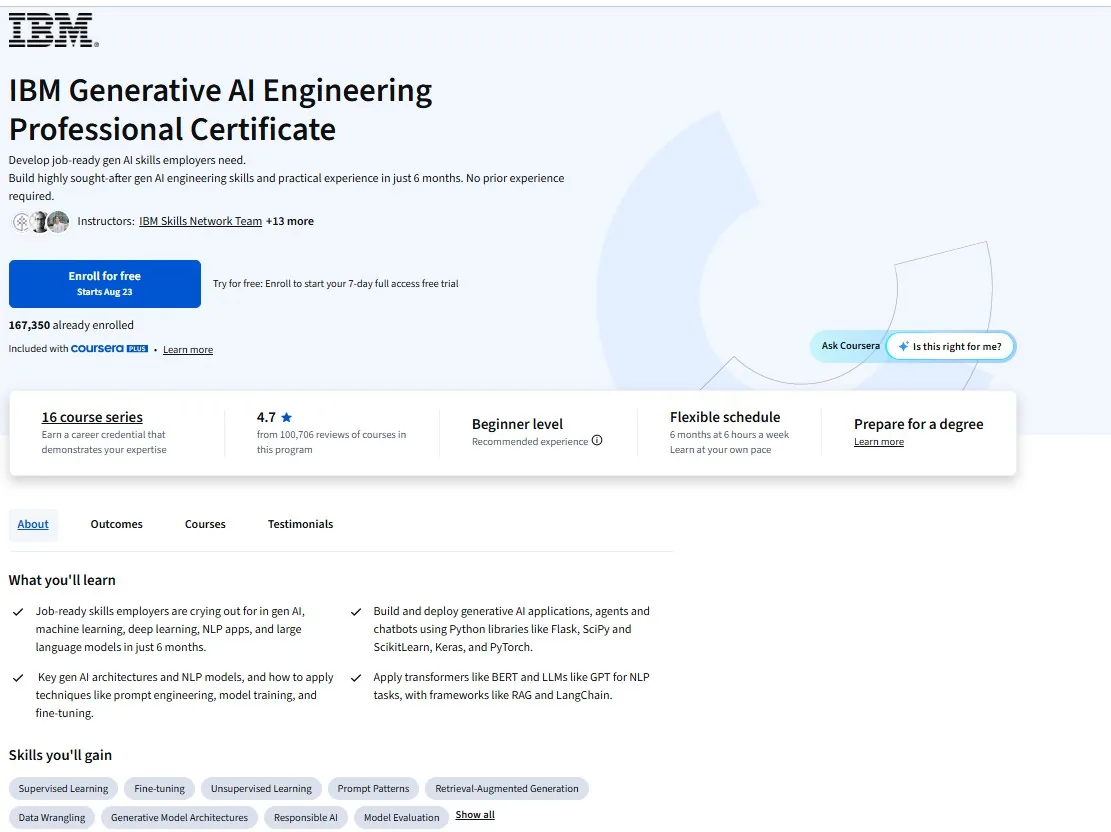
| 5 | IBM Generative AI Engineering Professional Certificate | Intermediate | ~188 hrs | Coursera (subscription or Plus) | A GenAI Job | 4.5 | Coursera → |
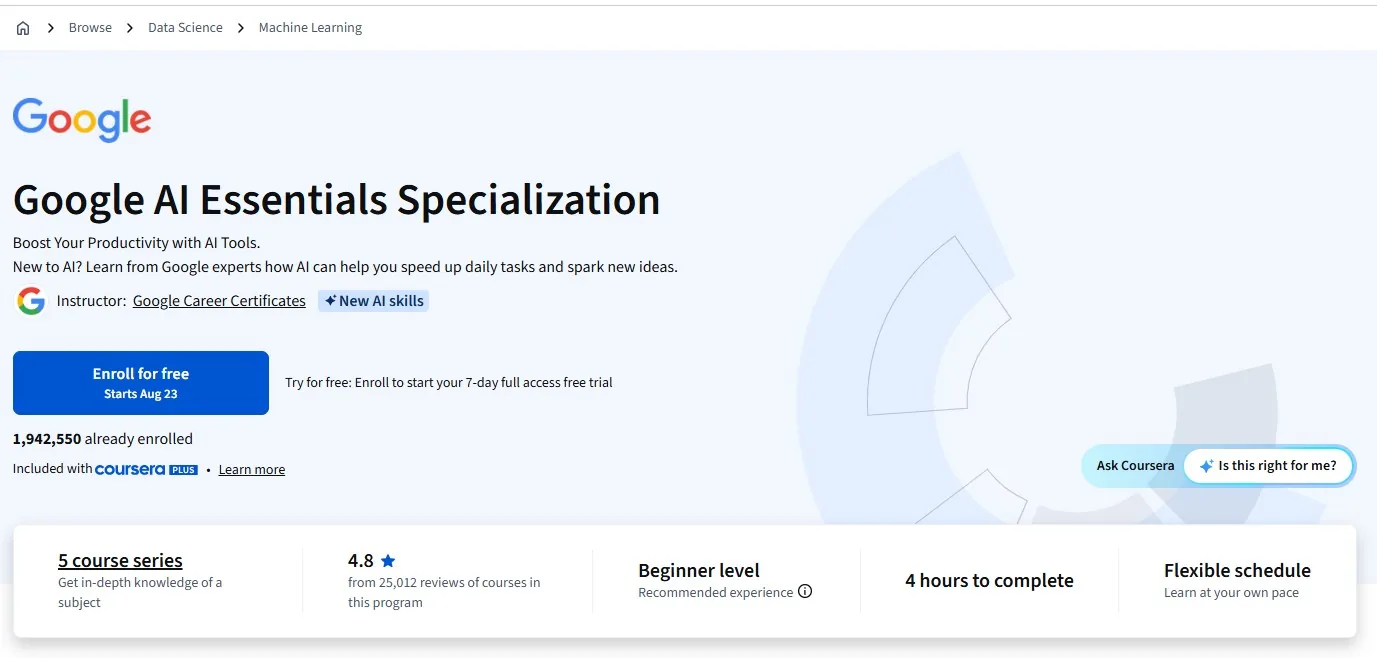
| 6 | Google AI Essentials | Beginner | ~6–10 hrs | Coursera (subscription or Plus) | Quick Credential | 4.3 | Coursera → |
| 7 | Generative AI for Everyone | Beginner | ~6 hrs | Coursera (subscription or Plus) | Beginners | 4.3 | Coursera → |
| 8 | Microsoft AI & ML Engineering Professional Certificate | Intermediate | ~178 hrs | Coursera (subscription or Plus) | Azure GenAI | 4.2 | Coursera → |
| 9 | AI For Everyone | Beginner | ~7 hrs | Coursera (subscription or Plus) | Leaders | 3.9 | Coursera → |
Not sure this is the right one for you?
Tell the picker about your background and what you want the certificate to do, and it narrows the list to the one or two courses we would start with. It suggests only our affiliate partners’ courses, and says so before it suggests anything.
Try the AI Certification Picker →Generative AI — LLMs like ChatGPT and Gemini, prompt engineering, and retrieval-augmented generation (RAG) — is the single hottest skill set in tech right now. Whether you want to use GenAI brilliantly or build with it, these nine certifications teach the most in-demand skills of 2026, ranked by who they're best for.
How to choose a generative AI certification
Pick based on how technical you want to get: non-technical fluency (use AI tools, prompt well), practitioner (build LLM apps, RAG, agents), or engineer (deploy GenAI systems in production). The list below spans all three so you can start where you are.
The 9 best generative AI certifications
AI Engineer Core Track: LLM Engineering, RAG, QLoRA, Agents
Best OverallThirty-three hours, bought once, and the syllabus is the one AI-engineering job adverts describe: RAG with vector embeddings, model evaluation, QLoRA fine-tuning and an autonomous multi-agent system in the final week. Updated June 2026. No examiner and no university name, so it earns its place here on what it teaches rather than on what the certificate says.
Read our full review of AI Engineer Core Track: LLM Engineering, RAG, QLoRA, Agents →
Why we score it 4.9 / 5
An applied AI-engineering syllabus — retrieval with vector embeddings, QLoRA fine-tuning, a multi-agent system — bought once with permanent access, which scores well on both factors we weight hardest and on cost. It assumes Python. Learner evidence, checked in a browser on the date below: 41,399 ratings averaging 4.7 from 342,668 learners, and a syllabus updated 2026-06. A course that many people finish and rate is market evidence of skill value; the certificate itself remains an unassessed completion record.
4.9 / 5 how well it teaches2.0 / 5 what the certificate is worth
Provider facts for this entry were last checked on 2026-09-14.
Developing AI Applications
Best for BuildingThe highest-scored subscription programme on this page and the one that actually has you build: the OpenAI API, prompt engineering against it, Hugging Face, embeddings and LangChain, with AI ethics and data privacy built into the track rather than bolted on the end. Twenty-one hours. It sits above the IBM certificate because generative AI is a building discipline and this is the shorter route to having built something.
Why we score it 4.8 / 5
An applied route through APIs, Hugging Face and vector databases. We value its focused scope for developers building applications. It is narrower than a broad machine-learning foundation and should be chosen for that specific learning goal.
4.8 / 5 how well it teaches3.0 / 5 what the certificate is worth
Provider facts for this entry were last checked on 2026-09-26.
Prompt Engineering Specialization (Vanderbilt)
Best for PromptingMaster the highest-leverage GenAI skill: getting consistently great output from LLMs. No coding, immediately useful for any role, and a university-backed credential. Our prompt engineering certification ranking compares it with five other courses that teach prompting.
Read our full review of Prompt Engineering (Vanderbilt) →
Why we score it 4.5 / 5
A structured approach to prompting for learners who want more than isolated examples. We value its accessibility, while treating its scope as a limitation for anyone needing software engineering, model training or deployment skills. A university-branded course certificate does not guarantee employer recognition.
4.3 / 5 how well it teaches4.0 / 5 what the certificate is worth
IBM AI Engineering Professional Certificate
Best ML Foundation for GenAIGenAI sits on top of machine learning. This certificate gives you the ML and deep-learning grounding (PyTorch, Keras) that makes you a stronger generative-AI engineer rather than just an API caller.
Read our full review of IBM AI Engineering →
Why we score it 4.5 / 5
A substantial engineering curriculum with Python, Keras and PyTorch. We value the depth but consider the study commitment a limitation for learners seeking a short introduction. We have no evidence that most enrolled learners fail to finish, and the score should not be read as a completion statistic.
4.6 / 5 how well it teaches4.0 / 5 what the certificate is worth
IBM Generative AI Engineering Professional Certificate
Best for a GenAI JobThe most complete, career-focused GenAI path. Covers large language models, prompt engineering, RAG architectures, and building real generative-AI applications — with hands-on labs and a portfolio. The strongest choice if you want a GenAI job.
Read our full review of IBM Generative AI Engineering →
Why we score it 4.5 / 5
Sixteen IBM courses from beginner Python to LLM applications: transformers, prompt engineering, fine-tuning, retrieval-augmented generation and LangChain, ending in a RAG project. We value that current stack, taught in pre-configured labs. It is long, about 188 hours by Coursera's course cards, broad rather than deep and light on evaluation and cost control; it also shares most of its courses with IBM AI Engineering.
4.6 / 5 how well it teaches4.0 / 5 what the certificate is worth
Google AI Essentials
Best Quick CredentialA fast, recognized certificate covering practical use of generative AI and responsible AI at work. Great to bank quickly alongside a deeper specialization.
Why we score it 4.3 / 5
A non-coding introduction to using AI at work. We favour its accessible starting point, but it is an orientation rather than technical engineering training. The Google course certificate does not demonstrate professional engineering competence.
3.8 / 5 how well it teaches4.2 / 5 what the certificate is worth
Provider facts for this entry were last checked on 2026-09-24.
Generative AI for Everyone (DeepLearning.AI)
Best for BeginnersAndrew Ng's accessible primer on how generative AI works and how to apply it productively — no coding. The perfect first step before deeper, technical programs, and ideal for non-technical professionals.
Read our full review of Generative AI for Everyone →
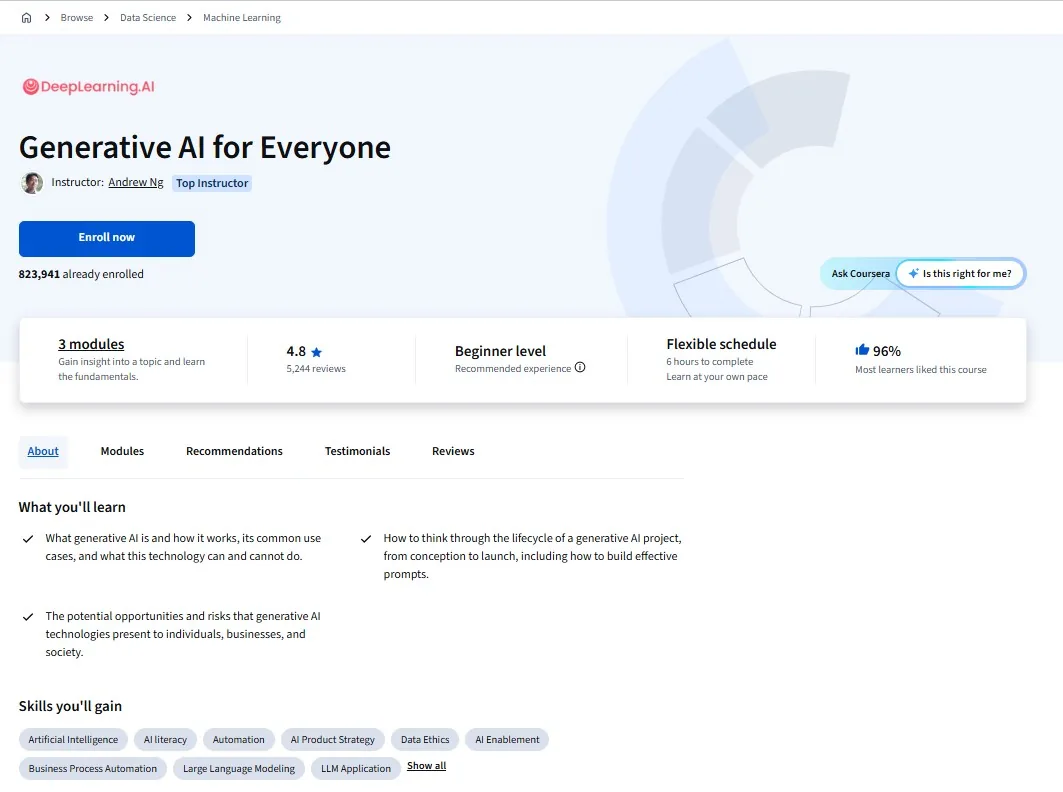
Why we score it 4.3 / 5
A short, non-coding DeepLearning.AI course, taught by Andrew Ng, on what generative AI can do for an organisation: how language models work and fail, prompting, and when to prompt, retrieve or fine-tune. We value its decision frameworks and that it can be finished in about six hours. It teaches judgement rather than hands-on skills, its coverage of agents is thin, and its certificate is a modest signal of AI literacy.
4.1 / 5 how well it teaches3.7 / 5 what the certificate is worth
Provider facts for this entry were last checked on 2026-09-24.
Microsoft AI & ML Engineering Professional Certificate
Best for Azure GenAIBuild and deploy AI — including generative AI — on Microsoft Azure. Ideal if your company runs on Microsoft's cloud.
Read our full review of Microsoft AI & ML Engineering →
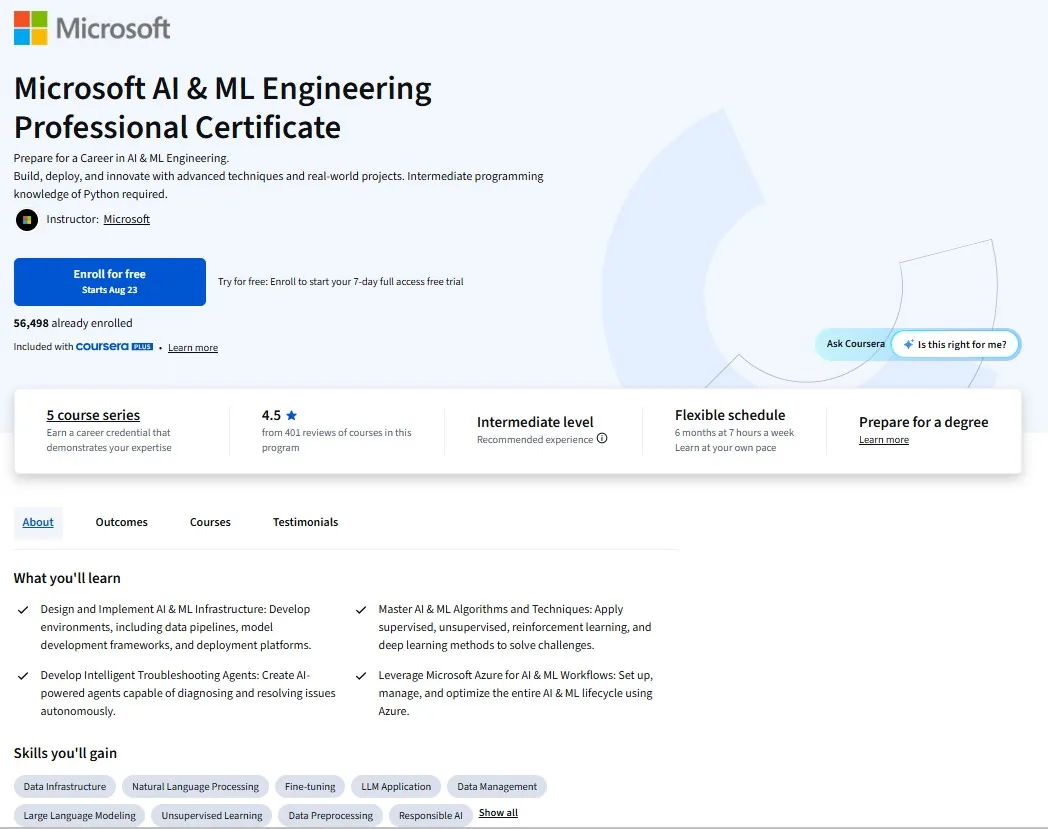
Why we score it 4.2 / 5
Five Microsoft courses about the production side of machine learning on Azure: deployment, MLOps, monitoring and responsible AI, with generative AI and a course on troubleshooting agents as components. We value its attention to what happens after a model works. It is long, assumes working Python and ties its labs to Azure, and it is coursework, not a Microsoft certification; we have not verified it as preparation for one.
4.4 / 5 how well it teaches4.0 / 5 what the certificate is worth
AI For Everyone (DeepLearning.AI)
Best for LeadersFor managers and decision-makers who need to understand what generative AI can realistically do, how to evaluate it, and how to lead AI initiatives — without the hype.
Read our full review of AI For Everyone →
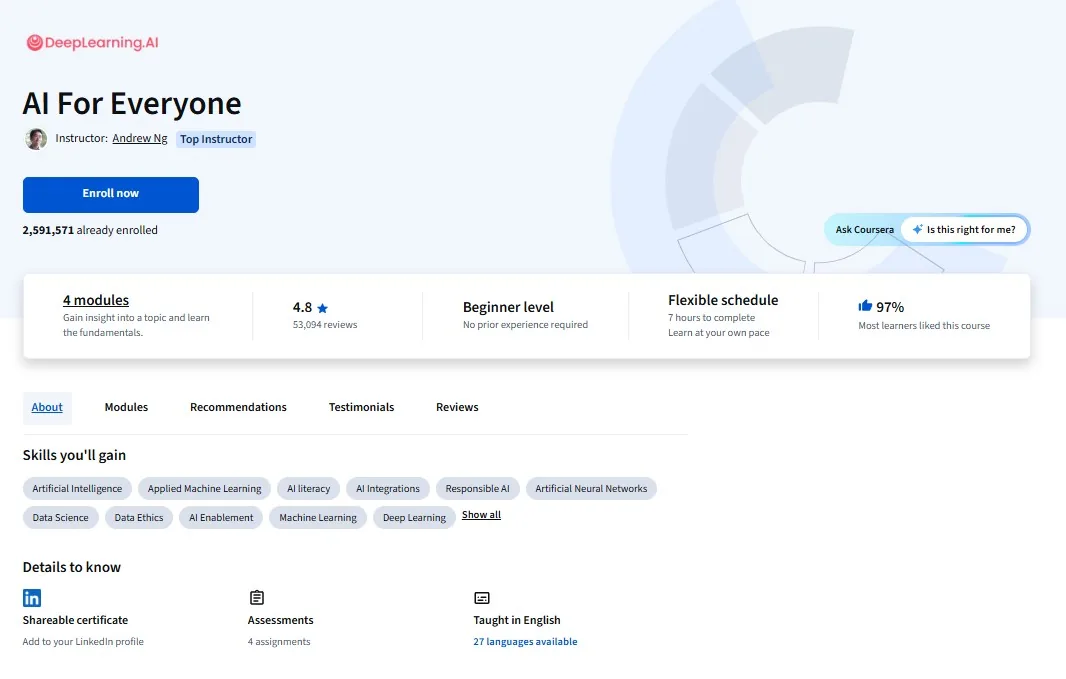
Why we score it 3.9 / 5
A short, non-coding DeepLearning.AI course, taught by Andrew Ng, on how organisations choose, staff and judge AI projects, with an AI transformation playbook. We value its organisational advice, which has aged well, and that it can be finished in about seven hours. What holds the score down is currency: built around supervised learning, it barely covers generative AI, and its widely held certificate signals basic literacy only.
3.8 / 5 how well it teaches3.4 / 5 what the certificate is worth
Provider facts for this entry were last checked on 2026-09-24.
What about the OpenAI certification — and agentic AI?
Two 2026 developments sit just beyond this list. First, OpenAI now offers two things: a free OpenAI Academy course badge, earned by completing a short course and passing its assessment, which OpenAI says is not a certification; and a formal OpenAI Certification that is still invite-only through ChatGPT Enterprise and Edu workspaces. The free badge complements rather than replaces the picks above; see our OpenAI certification guide for what exists and who can enroll today. Second, agentic AI — systems that plan and carry out multi-step tasks — is the next layer up from the generative-AI skills here: these certifications teach you to use and build with LLMs; agentic credentials focus on orchestrating them into autonomous workflows. Bank a GenAI credential first; it's the foundation the agentic material assumes.
If you would rather build one than study one
Most of the certifications above teach you about generative AI. This track, second in the ranking above, has you building with it: the OpenAI API, prompt engineering against it, Hugging Face, embeddings, data privacy, AI ethics, taking an OpenAI system to production, and LangChain. Twenty-one hours in Python, done as exercises in the browser. It is a skills track, not a certificate a recruiter will recognise — employer recognition is one of our six factors and this does not score on it — so the honest case for it is that you finish with something running rather than something framed.
Ready to start?
Included in a DataCamp subscription rather than bought outright. DataCamp's pricing page shows the plans and the price for your country, and one subscription covers the rest of its catalogue too.
Frequently asked questions
What is the best generative AI certification?
It depends on whether you want to build generative AI systems or use them well, and those are genuinely different products. For a hands-on, career-focused path, the IBM Generative AI Engineering Professional Certificate is the strongest option here — two to four months part-time, Python throughout, and it covers the working stack: LLMs, prompting, retrieval-augmented generation and fine-tuning.
For non-technical fluency, Generative AI for Everyone from DeepLearning.AI is the better answer and a fraction of the commitment at around six hours. It is aimed at understanding what these systems do, where they fail and how to spot a use case worth pursuing — which is what most roles actually need. Choosing the engineering certificate when you wanted the fluency one is the most expensive mistake available on this page, and it is usually made by reading the word “engineering” as “serious”.
Do I need to code for a generative AI certification?
Not for all of them, and the split is clean. Generative AI for Everyone and the Prompt Engineering Specialization require no coding whatsoever — they are about using these systems well, which is a skill in its own right and the one most jobs are currently asking for. Between them they run about six hours and about forty hours respectively.
The engineering-focused certificates are a different proposition. IBM Generative AI Engineering is Python throughout, though Coursera lists no prior experience as required because the programme teaches the language in one of its own courses; the cloud ML tracks expect it from the start. Either way you are building retrieval pipelines and fine-tuning models rather than prompting them. IBM's certificate alone is about 188 hours of work by Coursera's own course cards. Decide which side of that line you want to be on before you enrol, because the two paths share vocabulary and almost nothing else.
Is generative AI a good career in 2026?
The demand is real and well documented — generative AI skills appear across job postings well beyond engineering roles, and the pay for genuinely skilled practitioners is at the higher end of technology work. What we would not claim is that it is a guaranteed or permanent advantage, because nobody honestly knows that and the field has moved substantially in each of the last three years.
The more useful framing is that the skill compounds rather than that the title is safe. Learning to build with LLMs teaches retrieval, evaluation and working with unreliable outputs — all of which transfer to whatever the tooling looks like in three years. Roles named after a specific technology have a habit of being renamed; the underlying capability keeps its value. Treat a certificate as a structured way to acquire that, not as a claim on a job title.
What's the difference between a gen AI and a GenAI certification?
Nothing at all — this is a spelling question rather than a substantive one. “Gen AI”, “GenAI” and “generative AI” all refer to the same thing: AI systems that produce new content — text, images, audio, code — rather than only classifying or predicting from existing data. It is the technology behind ChatGPT, Gemini and Claude.
Providers use the terms interchangeably and inconsistently, sometimes within a single course description, so a certificate labelled one way is not different from one labelled another. If you are comparing options, ignore the spelling entirely and look at what the syllabus actually contains: whether it teaches prompting or building, whether it requires Python, and how long it runs. Those three answers separate every certificate on this page far more usefully than the name does.
Which is the best free generative AI certification?
Google Cloud’s introductory generative AI courses on Cloud Skills Boost are the strongest free option: free, genuinely beginner-friendly, and tied to a platform many employers already run.
Generative AI for Everyone from DeepLearning.AI is the better course, but it is not free. When its enrol screen was checked on 24 September 2026 it offered only the paid option — no free preview and no “Full Course, No Certificate” choice — so budget for it, or for a Coursera Plus subscription that covers it.
If the fee is what stands in the way, Coursera’s financial aid takes a discount off a course’s fee when your application is approved; you apply per course, with a wait of up to sixteen days. Our free certifications guide compares the full set.
How long does a generative AI certification take?
Anywhere from an afternoon to several months, and the spread is the most important thing to understand before choosing one. A fluency course like Generative AI for Everyone is about six hours — a single focused sitting. The Prompt Engineering Specialization is about forty hours, because it goes properly into reusable prompt patterns rather than tips.
Hands-on engineering certificates are a different order entirely: IBM Generative AI Engineering runs about 188 hours by its course cards — Coursera's pace is six months at six hours a week — and uses Python throughout, teaching it in one of its own courses rather than assuming it. That gap is not a difference in quality, it is a difference in what the course is for, and matching it to your actual goal matters more than picking the longest one. All of these are self-paced, so nothing expires if you stop — the real risk is drift rather than deadlines.
Is a generative AI certification worth it?
For most people, yes — with the value split unevenly between the two things it gives you. A recognised generative AI certificate signals current, in-demand skills (LLMs, prompting, retrieval) to someone screening a CV, and more usefully it imposes a structured path through a field where self-teaching tends to produce confident gaps.
Where the value collapses is with unaccredited badges. Stick to provider-backed certificates — IBM, DeepLearning.AI, Google, Vanderbilt — because those names mean something to a reviewer and the others do not. And the certificate is the smaller half regardless: pair it with one thing you actually built or changed, because that is what survives the first interview question. Our fuller answer on whether certifications are worth it goes into when they are not.
July 2026: added a table of contents, an at-a-glance comparison table, and an inline certification picker.