Amber enrol buttons are DataCamp affiliate links; we earn a commission if you enrol through them. How we're funded.
Quick answer
Take the IBM AI Engineering Professional Certificate if you can already code in Python and you want a portfolio-driven route into ML and AI engineering roles. It is project-heavy, employer-recognised and now covers generative AI and large language models, and we rate it 4.5/5. The catch is the size: about 168 hours by Coursera's course cards, which Coursera paces at four months of ten-hour weeks. If the hours are the obstacle, a shorter applied track will get you further than an abandoned certificate.
Where we would start on DataCamp
We choose these picks only among our affiliate partners’ courses (365 Data Science, DataCamp and Udemy). Our full ranking also includes courses that earn us nothing.
The hundred and sixty-eight hours this review keeps returning to is the real objection. Twenty-nine hours over the applied half of the same ground — API, embeddings, retrieval, agents — is the version most people actually finish.
Why this course, and its limitations
The current overall score reflects our emphasis on an applied syllabus: APIs, embeddings, vector databases, LangChain and LLMOps. The compact format can suit someone already comfortable with Python. Its limits are theoretical depth and credential scope: track completion does not award the separate DataCamp certification. We have no hiring-outcome or completion-rate data for this track.
Learning: 4.8/5. Credential: 3.0/5. These are separate editorial judgments, not learner ratings or job-placement statistics.
IBM's machine-learning and PyTorch courses are the model-training half the Developers track leaves out. This track covers them — supervised learning in scikit-learn, unsupervised learning, then two PyTorch courses — plus Hugging Face and Llama 3, in forty hours. It has no Keras or TensorFlow course and no capstone.
Why this course, and its limitations
A modelling-oriented counterpart to the developer track, covering training, fine-tuning, explainability and MLOps. We value that scope for someone already working in Python. It is a learning track, and completing it should not be presented as proof of professional competence.
Learning: 4.8/5. Credential: 3.0/5. These are separate editorial judgments, not learner ratings or job-placement statistics.
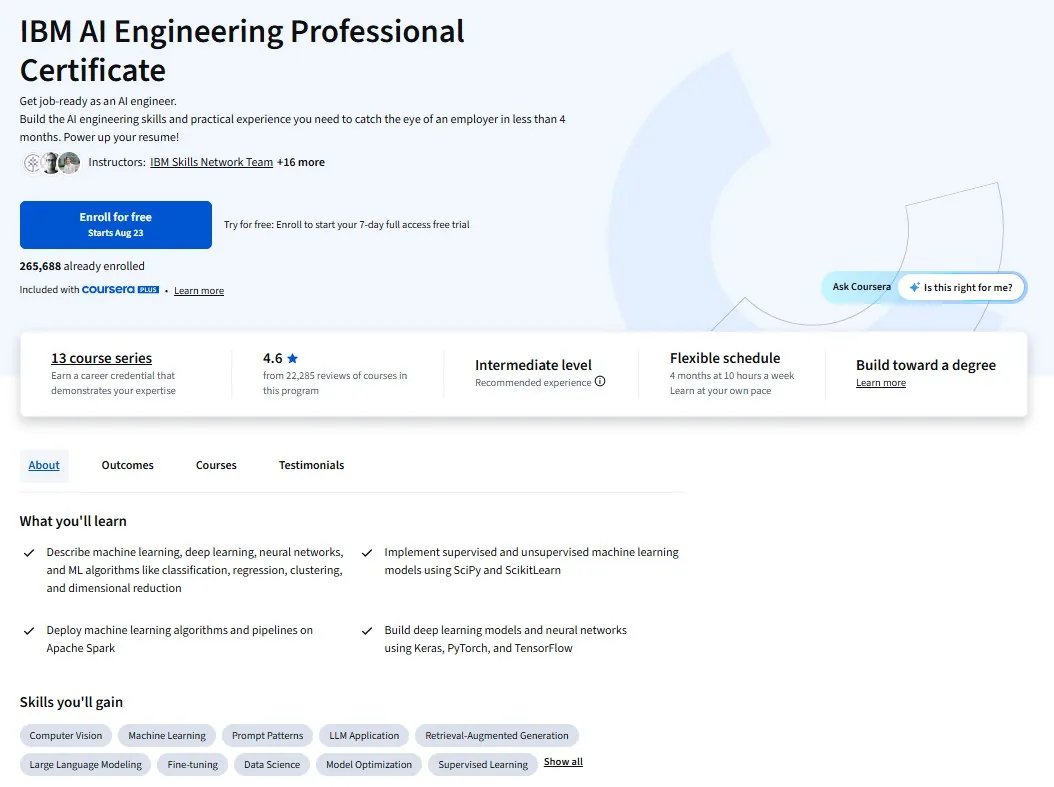
The IBM AI Engineering Professional Certificate is one of the most popular hands-on routes from "I know some Python" to "I can build and deploy AI." It's project-heavy, employer-recognized, and now expanded to cover generative AI and large language models. But it's a serious, multi-month commitment — so is it the right pick for you? Here's our honest review.
What is the IBM AI Engineering Professional Certificate?
It's a multi-course, self-paced program on Coursera that teaches the practical skills of an AI/ML engineer — building, training, and deploying models with industry-standard Python tools. It sits at the intermediate level: more technical than awareness courses like Google AI Essentials, and focused on actually building things rather than theory alone. IBM has broadened it to include generative AI and LLM content alongside the core deep-learning material.
What you'll learn
Five areas: machine learning in Python, deep learning in both Keras and PyTorch, the main architectures, generative AI and LLMs, and hands-on projects that build into a portfolio.
- Machine learning with Python — building and evaluating models using scikit-learn.
- Deep learning — neural networks with both Keras/TensorFlow and PyTorch.
- Architectures — convolutional neural networks (CNNs), recurrent networks (RNNs), autoencoders, and transformers.
- Generative AI & LLMs — seven newer courses covering transformer language models, fine-tuning, and retrieval-augmented generation with LangChain, ending in a project.
- Hands-on projects — applied labs throughout that build into a portfolio you can show employers.
The thirteen courses in the programme, in the order IBM and Coursera list them:
- Machine Learning with Python
- Introduction to Deep Learning & Neural Networks with Keras
- Deep Learning with Keras and Tensorflow
- Introduction to Neural Networks and PyTorch
- Deep Learning with PyTorch
- AI Capstone Project with Deep Learning
- Generative AI and LLMs: Architecture and Data Preparation
- Gen AI Foundational Models for NLP & Language Understanding
- Generative AI Language Modeling with Transformers
- Generative AI Engineering and Fine-Tuning Transformers
- Generative AI Advanced Fine-Tuning for LLMs
- Fundamentals of AI Agents Using RAG and LangChain
- Project: Generative AI Applications with RAG and LangChain
Not sure this is the right one for you?
Tell the picker about your background and what you want the certificate to do, and it narrows the list to the one or two courses we would start with. It suggests only our affiliate partners’ courses, and says so before it suggests anything.
Try the AI Certification Picker →The details: cost, time, prerequisites
It's a series of thirteen self-paced courses, which Coursera lists at between 6 and 23 hours each. Because it's accessed through a Coursera Plus subscription priced per country, the faster you work, the less you pay, and motivated learners can finish well inside Coursera's four-month pace. Coursera says it cannot be taken for free, but you can apply for financial aid — separately for each course in the certificate, with up to 16 days for each decision. Prerequisites: comfort with Python and a basic grasp of ML concepts.
How we checked this. We list the cost as Coursera Plus subscription (priced per country). Source: Coursera prices Plus regionally; no single global figure is safe to publish. Where we give a figure, the source says when we read it on the provider's page. We re-read prices by hand and publish no figure we cannot source — where a provider prices regionally, we say so rather than quote a number that is wrong for most readers.
Pros and cons
✓ What we liked
- Genuinely hands-on — you build real models, not just watch lectures
- Covers both Keras/TensorFlow and PyTorch (rare and valuable)
- Produces a portfolio employers can see
- Now includes generative AI and LLMs
- Recognized IBM brand; included in Coursera Plus
✕ What to keep in mind
- Requires Python — not for absolute beginners
- A multi-month commitment
- Less brand prestige than Stanford/DeepLearning.AI for pure theory
Who should take it (and who shouldn't)
Take it if you can already code in Python (or you've finished a fundamentals course) and you want a practical, portfolio-driven path into ML/AI engineering roles. It's ideal for developers, data analysts, and career switchers who learn best by building.
Start elsewhere if you're a complete beginner — do the Machine Learning Specialization or Google AI Essentials first, or IBM’s own beginner programme, the IBM AI Developer Professional Certificate, which shares none of this certificate’s courses — then come back to this for the hands-on depth.
Take the shorter, application-side route instead if the roles you want are about shipping features that call a model rather than training one. That is a real and growing category of job, and 168 hours of CNNs and autoencoders is a slow way to arrive at it. DataCamp's Associate AI Engineer for Developers is 29 hours over the same territory the adverts name — the API, embeddings, a vector database, LangChain, MCP. It assumes you already write Python, it teaches you nothing about training models, and it has no IBM logo on it. Those are the three things you are trading away; decide whether you need them.
How it compares to the alternatives
The IBM AI Engineering certificate competes with a few other well-known technical programs. Here's where it fits:
The table below compares 5 programs on best for, level and total hours. Hours are each provider's own figure: for the four Coursera programmes it is the sum of the hours on their course cards, because Coursera's headline states only a pace (“3 months at 10 hours a week”).
| Program | Best for | Level | Total hours | Enrol |
|---|---|---|---|---|
| IBM AI Engineering | Hands-on, portfolio-first model building | Intermediate | 168 | Coursera → |
| Machine Learning Specialization | Foundations & intuition first | Beginner–Int. | 95 | Coursera → |
| Deep Learning Specialization | Neural-network theory depth | Intermediate | 129 | Coursera → |
| Microsoft AI & ML Engineering | Azure-based teams | Intermediate | 178 | Coursera → |
| Associate AI Engineer for Developers (DataCamp) | Building products on top of models | Intermediate | 29 | DataCamp → |
If you're new to ML, do the Machine Learning Specialization first, then come here for the hands-on depth. See how the two IBM tracks differ in our IBM AI Engineering vs Generative AI Engineering comparison. If building applications on large language models is the goal rather than training models, read our IBM Generative AI Engineering Professional Certificate review instead. It is a separate programme, but most of this certificate’s courses are also in it, so taking both repeats much of the same material.
The last row on that table is the one worth reading carefully, because the two programs share a job title and teach different jobs. IBM's is model-centric: you train models, work in both Keras and PyTorch, learn the architectures, and — in the newer modules — fine-tune and deploy language models. DataCamp's Associate AI Engineer for Developers is application-centric: calling the OpenAI API, embeddings and a vector database, LangChain, LLMOps and the Model Context Protocol, with no training loop in sight. Roughly, IBM prepares you to build the model; DataCamp prepares you to build the product around somebody else's. Read the job advert you are aiming at and see which half it actually describes — in 2026 a lot of them describe the second, and the 145-hour difference is mostly the mathematics you would need for the first.
Is the IBM AI Engineering certificate worth it?
For its target audience, yes — it's one of the best value, most practical AI-engineering programs available, and the addition of generative-AI content keeps it current. We rate it 4.5 out of 5. Pair it with a couple of personal projects and it becomes a genuinely strong signal for ML/AI roles.
Why we score it 4.5 / 5
A substantial engineering curriculum with Python, Keras and PyTorch. We value the depth but consider the study commitment a limitation for learners seeking a short introduction. We have no evidence that most enrolled learners fail to finish, and the score should not be read as a completion statistic.
4.6 / 5 how well it teaches4.0 / 5 what the certificate is worth
Ready to start?
Included in a DataCamp subscription rather than bought outright. DataCamp's pricing page shows the plans and the price for your country, and one subscription covers the rest of its catalogue too.
Frequently asked questions
Is the IBM AI Engineering Professional Certificate worth it?
Yes, if you want a hands-on route into ML and AI engineering and you already write Python comfortably. It teaches deep learning with Keras and PyTorch, now covers generative AI including retrieval-augmented generation, and — the part that matters most — it finishes with a portfolio of models you have actually built and deployed rather than a set of completed quizzes.
It is the wrong choice if you want a quick, non-technical credential. This is roughly 168 hours of real work at an intermediate level, and the coursework assumes Python you already have rather than teaching it. If that describes you, Google AI Essentials is a better fit at six to ten hours with no coding at all. The honest test is whether you want to build AI systems or use them well; those are different goals and this certificate only serves the first.
Do I need coding experience for the IBM AI Engineering certificate?
Yes — comfort with Python and a working grasp of basic machine-learning concepts. It is pitched at intermediate level and does not pause to teach programming, so arriving without it is the most reliable way to stall a few weeks in. You do not need to be a professional developer, but you should be able to read and modify a script without looking up syntax constantly.
Complete beginners have a clear route in. Start with the Machine Learning Specialization, which covers the fundamentals this course assumes and uses light Python throughout, or with Google AI Essentials if you want to know whether you enjoy the subject before committing months to it. Neither is wasted time — skipping the foundation is the single most common reason people abandon the harder certificate.
How long does the IBM AI Engineering certificate take?
About 168 hours of actual work by the course cards on Coursera's page, which frames it as roughly four months at ten hours a week. We quote the hours rather than the months because a month is not a duration — it depends entirely on the pace you assume, and the same certificate is honestly “eight months” at five hours a week or “two months” at twenty.
Everything is self-paced across the constituent courses, so nothing expires if you stop and come back, and the real risk is drift rather than deadlines. The practical advice is to pick a weekly number of hours you can actually sustain alongside work and divide 168 by it — that gives you a finish date you might meet, rather than the optimistic one. Build the portfolio projects as you go rather than saving them for the end.
IBM AI Engineering vs Machine Learning Specialization — which first?
The Machine Learning Specialization first, in almost every case. It teaches the foundations — how models actually learn, why overfitting happens, how you tell a good result from a lucky one — and IBM AI Engineering assumes all of it silently. Roughly 95 hours against 168, so it is also the smaller commitment to discover the subject with.
Then IBM AI Engineering for the hands-on, portfolio-building depth: Keras, PyTorch, deployed models, generative AI. The two are complementary rather than competing, and the order is not arbitrary. The exception is if you already have the fundamentals from a degree or from work — in which case open the second course of the Specialization, see whether you could complete its assignments today, and skip ahead if the answer is clearly yes.