Amber enrol buttons are DataCamp and Udemy affiliate links; we earn a commission if you enrol through them. How we're funded.
Quick answer
The Machine Learning Specialization is worth it if you want to understand how machine learning actually works and you will give it about ninety-five hours. Andrew Ng’s rebuilt Stanford and DeepLearning.AI specialization is still the strongest foundation we review and we rate it 4.6/5. It loses ground on one thing only: the syllabus predates the LLM era, so it will not teach you retrieval, agents or the tooling around large language models. Take it for fundamentals, not for a 2026 job description.
Where we would start on DataCamp or Udemy
We choose these picks only among our affiliate partners’ courses (365 Data Science, DataCamp and Udemy). Our full ranking also includes courses that earn us nothing.
The alternative this review weighs against: sixteen hours to ninety-five, over much of the same supervised and unsupervised ground. Far less depth and none of Andrew Ng's teaching — but the completion rate is the entire argument for it.
Why this course, and its limitations
A compact overview of supervised and unsupervised learning with additional neural-network and reinforcement-learning material. The important limitation is prerequisites: the track opens on scikit-learn without a Python course, so we classify it as Intermediate. Its breadth is not evidence of mastery.
Learning: 4.6/5. Credential: 3.0/5. These are separate editorial judgments, not learner ratings or job-placement statistics.
The counterweight to the course reviewed above. Stanford's is stronger teaching and a stronger name; this is broader, cheaper, bought once rather than rented monthly, and includes territory Andrew Ng's leaves out entirely. It is not the better course — it is the better fit for someone who wants coverage.
Why this course, and its limitations
A long, broad introduction to machine learning in Python and R, bought once. Its scale and update cadence make it a common first course; it is not current on LLM tooling and its certificate is a completion record. Learner evidence, checked in a browser on the date below: 206,007 ratings averaging 4.5 from 1,222,992 learners, and a syllabus updated 2026-06. A course that many people finish and rate is market evidence of skill value; the certificate itself remains an unassessed completion record.
Learning: 4.5/5. Credential: 2.0/5. These are separate editorial judgments, not learner ratings or job-placement statistics.
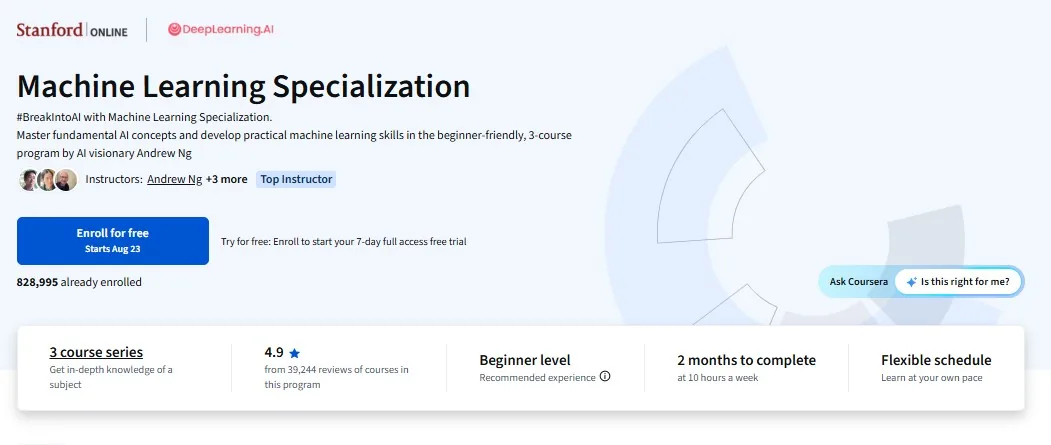
If there's one course that defined how the world learns machine learning, it's this one. The Machine Learning Specialization — created by Andrew Ng with Stanford and DeepLearning.AI — is the modern rebuild of the legendary original taken by millions. With a 4.9 learner rating on Coursera and unmatched reputation, it is our pick for the best AI foundation we review. Here's our full review.
What is the Machine Learning Specialization?
It's a three-course program that gives a broad, practical introduction to modern machine learning. Taught by Andrew Ng — one of the most respected names in AI — it rebuilds his pioneering Stanford course for today, balancing intuition, math, and hands-on Python so you actually understand what you're building. It is not Stanford's graduate certificate, which carries academic credit and costs far more; our university AI certificates comparison sets the two side by side with Harvard, MIT and UT Austin.
What you'll learn (all three courses)
The Machine Learning Specialization is built as three sequential courses that take you from zero to genuinely capable:
- Supervised Machine Learning: Regression and Classification. The foundations — linear and logistic regression, cost functions, and gradient descent — implemented in Python with NumPy and scikit-learn. You come out understanding how a model actually learns, not just how to call a library.
- Advanced Learning Algorithms. Neural networks (built and trained in TensorFlow), decision trees, and ensemble methods, plus the practical craft that separates working models from broken ones: bias/variance, error analysis, and how to decide what to try next.
- Unsupervised Learning, Recommenders, Reinforcement Learning. Clustering and anomaly detection, recommender systems, and an approachable introduction to reinforcement learning — rounding out the modern ML toolkit.
Crucially, it teaches intuition first, math second, code throughout. That balance is why it works for beginners without being watered down — you finish able to frame a problem as an ML task, pick a sensible model, train it, and reason about why it's underperforming.
Why it is still the best teaching of ML fundamentals
We score every certification on six factors, and the Machine Learning Specialization earns 4.6/5. It is no longer the top score in our 2026 rankings — the August 2026 re-weighting moved shorter, more current programmes above it, and its syllabus predates the LLM era. It is still the best teaching of the fundamentals we review, and three things set it apart. First, the instructor: Andrew Ng effectively taught a generation of ML practitioners, and the "Andrew Ng / Stanford" line carries genuine weight with technical hiring managers. Second, the pedagogy — it's famous precisely because hard ideas are made to feel obvious, with hands-on labs at every step. Third, it's vendor-neutral: the fundamentals transfer to any cloud, framework, or job, so it doesn't age the way a tool-specific course does. It's the foundation most other paths on this site build on.
The details: cost, time, difficulty
It's accessed through a Coursera Plus subscription, billed monthly or annually and priced per country; on the monthly plan, the faster you finish, the less you pay. Basic Python and some high-school-level math make it smoother, but it's built to bring beginners up to speed.
Can you take it for free? No. Coursera's own FAQ for the Specialization says it cannot be taken for free, and points learners who cannot afford it to financial aid. Aid is granted per course, so the Specialization means one application for each of its courses, and each can take up to 16 days to review. The first module of a Coursera course can usually be previewed free, which is enough to judge the teaching before you pay or apply.
How we checked this. We list the cost as Coursera Plus subscription (priced per country). Source: Coursera prices Plus regionally; no single global figure is safe to publish. Where we give a figure, the source says when we read it on the provider's page. We re-read prices by hand and publish no figure we cannot source — where a provider prices regionally, we say so rather than quote a number that is wrong for most readers.
Pros and cons
✓ What we liked
- World-class instructor and reputation
- Beginner-friendly yet genuinely substantial
- Vendor-neutral, transferable knowledge
- Outstanding 4.9 learner rating on Coursera
- Excellent value via Coursera Plus
✕ What to keep in mind
- Requires basic Python and some math comfort
- More time commitment than a short course
- Not focused on a specific cloud vendor
Who should take it (and who shouldn't)
Take it if you want to genuinely understand how AI works — whether you're aiming for a data or ML role, you're a developer adding ML skills, or you're an ambitious beginner ready for something deeper than an awareness course.
Skip it if you only need non-technical AI fluency for your job — in that case, Google AI Essentials is faster and easier, and it asks six to ten hours of you rather than ninety-five.
Take something shorter if you want the technical content but know, honestly, that 95 hours of video and notebooks is not going to happen alongside a job. This is the most common way people fail here, and it is not a failure of ability — an abandoned Specialization teaches you nothing and still costs you two months of subscription. DataCamp's Machine Learning Fundamentals in Python covers regression, classification, model evaluation and clustering in 16 hours of browser exercises. You will come out with less depth and no Stanford name on the certificate. You will also come out having finished, which is the whole point.
How it compares to the alternatives
This is the foundation most other paths build on. Here's how it compares to the courses people consider alongside it:
The table below compares 5 courses on best for, coding and total hours. Hours are each provider's own figure. For the three Coursera programmes it is the sum of the hours on their course cards, because Coursera's headline states only a pace ("2 months at 10 hours a week").
| Course | Best for | Coding | Total hours | Enrol |
|---|---|---|---|---|
| Machine Learning Specialization | The best all-round foundation | Light Python | 95 | Coursera → |
| Deep Learning Specialization | Going deeper into neural nets | Python | 129 | Coursera → |
| IBM AI Engineering | Hands-on, portfolio building | Python | 168 | Coursera → |
| Machine Learning Fundamentals in Python (DataCamp) | Finishing at all, when 95 hours will not happen | Python, in the browser | 16 | DataCamp → |
| Google AI Essentials | Non-technical AI fluency | None | 6–10 | Coursera → |
Most learners do this first, then branch into the Deep Learning Specialization or a hands-on program like IBM AI Engineering. If you only need to use AI at work rather than build it, start with Google AI Essentials instead.
The one entry on that table that is not really a rival is DataCamp's Machine Learning Fundamentals in Python, and it is there for a specific reader. It covers a fair share of the same ground — supervised learning with scikit-learn, unsupervised learning and clustering, a first neural network in PyTorch, even a look at reinforcement learning — in 16 hours of browser exercises rather than 95 hours of lectures and notebooks. It is genuinely shallower, and it will not give you the intuition this Specialization is famous for. But 16 hours you finish is worth more than 95 you abandon in week three, which is the actual outcome for a lot of people who start here. Be honest with yourself about which of those two you are.
Not sure this is the right one for you?
Tell the picker about your background and what you want the certificate to do, and it narrows the list to the one or two courses we would start with. It suggests only our affiliate partners’ courses, and says so before it suggests anything.
Try the AI Certification Picker →Is the Machine Learning Specialization worth it?
Absolutely. It remains the gold standard for learning machine learning from the ground up, and the brand value of "Andrew Ng / Stanford" on your résumé is real. We rate it 4.6 out of 5 — the highest of any Coursera programme we review.
Why we score it 4.6 / 5
Our preference for a structured machine-learning foundation. Its emphasis on underlying methods is useful for learners who want to understand models, while a focused application course may suit an experienced developer seeking a specific tool. Plan for sustained study and Python practice; we have no course-specific completion-rate data.
4.9 / 5 how well it teaches4.3 / 5 what the certificate is worth
Ready to start?
Included in a DataCamp subscription rather than bought outright. DataCamp's pricing page shows the plans and the price for your country, and one subscription covers the rest of its catalogue too.
Frequently asked questions
Is the Machine Learning Specialization worth it?
Yes — it rates 4.6/5 in our rankings, and for anyone who wants to genuinely understand machine learning rather than just use AI tools, it is the best-value foundation available.
Three things earn that. Andrew Ng teaches intuition before mathematics, so concepts land before the notation arrives. It is vendor-neutral, covering supervised and unsupervised learning and neural networks rather than one company's platform, which is why it has not dated. And it is genuinely beginner-accessible while remaining substantial enough that finishing it means something.
It is the wrong choice if you want practical AI skills for an office role — that is Google AI Essentials, in a tenth of the time — or if you want to build and deploy applications immediately, where IBM AI Engineering is the more project-first path.
Do I need to know how to code for this course?
Yes, but less than people expect. The course uses Python throughout and you will be reading and editing code from early on, so it is not a no-code option. What it does not require is that you arrive as a competent programmer — the programming is a vehicle for the ideas, not the subject being taught, and the material builds up what you need as it goes.
A useful test: if you can follow a short Python script and change a variable without panicking, you have enough to start. If you have never written a line of code in your life, this is the wrong first course — not because you could not do it, but because you would be learning two hard things at once.
In that case start with Google AI Essentials, which needs no coding at all, and come back to this once the ideas are familiar.
How long does the Machine Learning Specialization take?
About 95 hours in total — Coursera's own pace is two months at ten hours a week, spread across the three courses in the specialization. It is entirely self-paced, so that figure moves considerably with how much time you give it — a focused learner doing an hour a day will finish faster, and stopping for a fortnight costs you nothing but momentum.
The pace is not evenly distributed. The first course establishes supervised learning and takes most people the longest, because it is where the mental model is built. The later material moves faster once that foundation is in place.
Budget for the programming exercises rather than just the lectures. They are where the understanding actually forms, and skipping them is the most common way people finish the course without retaining much of it.
Is the Machine Learning Specialization good for beginners?
It is genuinely good for beginners to machine learning — it is not a beginner course in the sense of assuming nothing at all. It starts from first principles rather than assuming prior machine-learning knowledge, and Andrew Ng teaches intuition before the mathematics arrives, which is why it manages to be accessible without being shallow.
The prerequisite that catches people is Python, not difficulty. Complete beginners to machine learning do fine here; complete beginners to programming struggle, because they end up learning to code and learning to model simultaneously.
The other thing to be honest about is scope. This runs about 95 hours; Coursera's own pace is two months at ten hours a week. If what you actually want is to use AI tools well at work, that is a different goal and a shorter course serves it better — see our beginner guide. If you want to understand how the models work, this is the one.
Is the Machine Learning Specialization free?
No. Coursera’s own FAQ for the Specialization says it cannot be taken for free, and points anyone who cannot afford the fee to financial aid. Each course can be started in Preview at no cost, which inside a Specialization opens the course materials but locks the graded assessments — enough to judge the teaching style, not to earn the certificate.
To get the course and the certificate there are two routes. Coursera’s financial aid gives an approved learner a discount off each course’s price, sized by the application and location, and it is granted per course, so a three-course Specialization means three applications, each made once you have completed the course before it. Our financial aid guide walks through the application step by step.
Otherwise it is included in a Coursera Plus subscription, which is priced per country and covers most of the specializations and professional certificates we rank.
Do I need to be good at math?
No. This is the most common reason people talk themselves out of the course, and it is the wrong reason. The whole design principle is intuition first and mathematics second: concepts land before the notation arrives, and the notation is then introduced as a way of writing down something you already understand.
Comfort with basic algebra helps, in the sense that seeing symbols rearranged should not stop you. You do not need to arrive with university-level calculus or linear algebra, and you are not expected to derive anything from scratch.
What the course does ask for is tolerance rather than talent — you will meet notation that looks worse than it is, and the skill being trained is staying with it long enough for the explanation to catch up. People who found school mathematics unpleasant routinely finish this. People who quit usually quit in week one, at the first equation, before the explanation lands.
Machine Learning Specialization vs Deep Learning Specialization — which first?
This one, first, in almost every case. The Machine Learning Specialization is the foundation — supervised and unsupervised learning, how models are trained and evaluated, why they fail — and it rates 4.6/5 here, and nothing we review teaches the fundamentals better. The Deep Learning Specialization (4.5/5) goes deeper on neural networks specifically, and it is a better course for someone who already has the groundwork.
Taking them in the other order is the common mistake. Deep learning without the fundamentals means you can build a network that trains and still have no idea why it is not working, because diagnosing that is a machine-learning skill rather than a neural-network one.
The exception is a narrow one: if you already work with models day to day and want depth on architectures rather than breadth on fundamentals, go straight to Deep Learning. Otherwise this first, then that.
Is it still worth it in 2026?
Yes, and arguably more than when it launched. The obvious objection is that generative AI has moved on since — but what moved on is the tooling, and this course does not teach tooling. It teaches how models learn, why they fail, and how to tell a working model from one that only appears to work, which is what makes it vendor-neutral and why it has not dated.
Generative AI has, if anything, raised the value of the fundamentals. Plenty of people can now call an API; far fewer can say why a model's output is unreliable on their data, and that gap is where the fundamentals pay.
Where it is not worth it is unchanged: if your goal is to apply AI tools at work rather than understand them, this is a two-to-three-month answer to a question a much shorter course answers better.
Do you get a certificate, and what does it say?
Yes, if you pay: completing all three courses earns a Coursera specialization certificate that names Stanford Online and DeepLearning.AI, with your name and the completion date, and it can be added to LinkedIn. There is no free way to the certificate except financial aid: Coursera's FAQ for the Specialization says it cannot be taken for free. What it does not say is that you passed an exam: it records that you finished the coursework and its quizzes and programming assignments, which is more than most course certificates but less than a vendor exam. Treat it as evidence you did the work, and keep the notebooks you built, because those are what an interviewer will ask about.
Updated July 2026. Expanded the course-by-course breakdown, added a "why it's rated the way it is" section and free-access details, and grew the FAQ.