Amber enrol buttons are DataCamp and Udemy affiliate links; we earn a commission if you enrol through them. How we're funded.
Quick answer
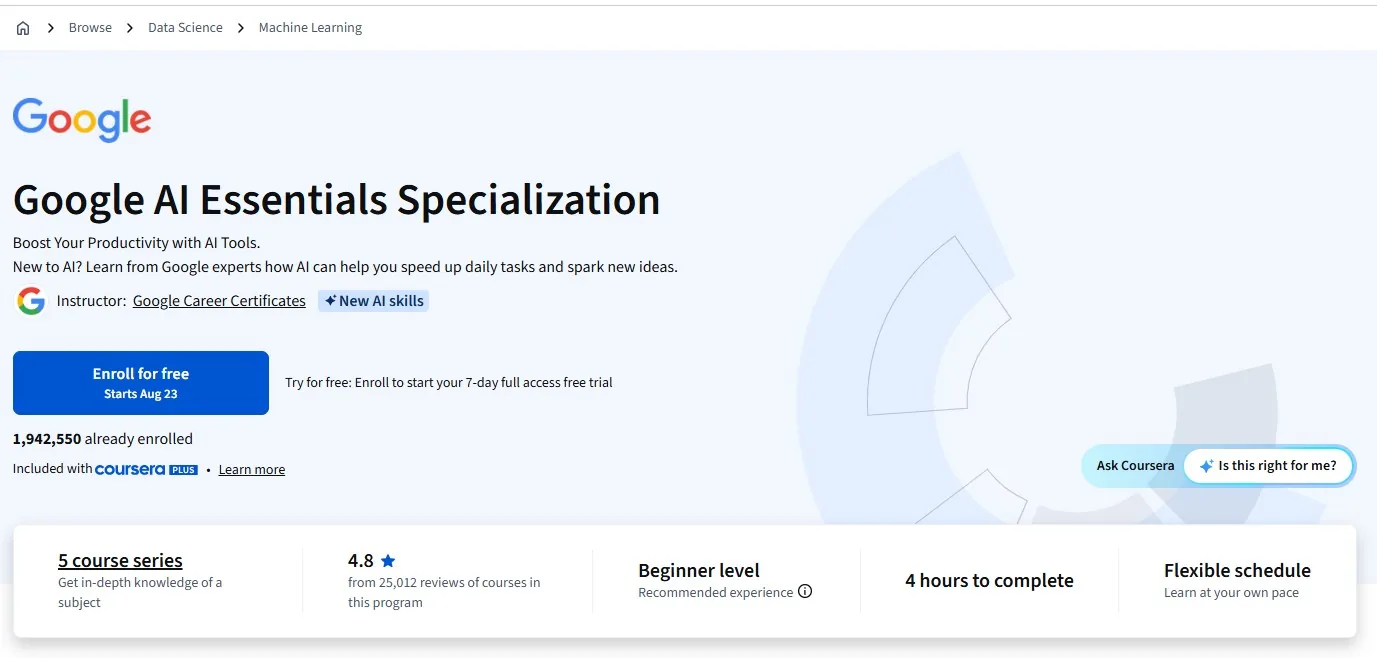
Google AI Essentials, Google’s five-course, no-code programme on Coursera, is a sound first step for non-technical professionals who want to use AI tools at work and have a recognised name to show for it. Google AI Essentials costs $49 a month in the US and Canada after a 7-day free trial, or comes with Coursera Plus; Coursera’s own FAQ says it cannot be taken for free. It ends in a course certificate from Google, not a proctored exam, and takes about six to ten hours by our estimate. Several beginner options on our ranking score higher. 4.3 / 5.
Why we score it 4.3 / 5
A non-coding introduction to using AI at work. We favour its accessible starting point, but it is an orientation rather than technical engineering training. The Google course certificate does not demonstrate professional engineering competence.
3.8 / 5 how well it teaches4.2 / 5 what the certificate is worth
Provider facts for this entry were last checked on 2026-09-24.
Where we would start on DataCamp or Udemy
We choose these picks only among our affiliate partners’ courses (365 Data Science, DataCamp and Udemy). Our full ranking also includes courses that earn us nothing.
Two hours with a prompting framework you can use the same afternoon, graded in the browser; the same orientation Google AI Essentials gives, without the Coursera pace and with exercises instead of videos.
Why this course, and its limitations
A short non-coding introduction for readers deciding how AI might fit their work. We favour its limited initial commitment. It provides orientation rather than professional qualification, and we do not have learner completion or employment-outcome data.
Learning: 4.3/5. Credential: 2.8/5. These are separate editorial judgments, not learner ratings or job-placement statistics.
The bought-once alternative to the course this page reviews: two and a half hours on what AI is and where it fits, for the reader who wants to decide before paying for a subscription or a Google certificate.
Why this course, and its limitations
A short starting point, bought once, with no coding requirement or prerequisites stated by the provider. We value it for deciding whether to study AI further; the limited depth makes it orientation rather than preparation for a technical role. Learner evidence, checked in a browser on the date below: 34,203 ratings averaging 4.5 from 105,982 learners, and a syllabus updated 2026-01. A course that many people finish and rate is market evidence of skill value; the certificate itself remains an unassessed completion record.
Learning: 4.3/5. Credential: 2.0/5. These are separate editorial judgments, not learner ratings or job-placement statistics.
Google AI Essentials has quickly become one of the most popular entry points into AI — and for good reason. It's short, affordable, requires no technical background, and carries a brand that hiring managers instantly recognize. But is it actually worth your money? Here's our honest take.
- Where we would start on DataCamp or Udemy
- What is Google AI Essentials?
- What you'll learn
- The details: cost, time, format
- Pros and cons
- Who should take it (and who shouldn't)
- How it compares to the alternatives
- Is Google AI Essentials worth it?
- Before you commit to this one
- Frequently asked questions
What is Google AI Essentials?
Google AI Essentials is a self-paced, five-course Specialization on Coursera, created by Google, that teaches working professionals how to use generative AI in their day-to-day jobs. It assumes zero prior knowledge — no coding, no math, no AI experience. The focus is entirely practical: how to get useful results from AI tools and how to do it responsibly.
It is not Google's only AI certificate on Coursera. The Google AI Professional Certificate is a separate, longer programme of eight courses that repeats these fundamentals and then applies them to research, writing, content, data analysis and building a small app; our review of it sets out which of the two to take.
What you'll learn
Four areas: how generative AI works, prompting, everyday productivity, and using AI responsibly at work.
- How generative AI works — enough to understand what it can and can't do.
- Prompting skills — writing clear, effective prompts to get better output.
- Productivity — using AI to speed up writing, brainstorming, summarizing, and everyday tasks.
- Responsible AI — spotting bias, protecting privacy, and using AI ethically at work.
The five courses in the programme, in the order Google and Coursera list them:
- Introduction to AI
- Maximize Productivity With AI Tools
- Discover the Art of Prompting
- Use AI Responsibly
- Stay Ahead of the AI Curve
The details: cost, time, format
It's a five-course Specialization, but the courses are short ones — this is far closer to a weekend of work than to the multi-month programs it sits alongside. Coursera's own page gives different figures for it in different places; we think six to ten hours is realistic once you actually try the exercises. Coursera's own FAQ says it cannot be taken for free, but financial aid is available if cost is a barrier: you apply course by course, and each application can take up to 16 days to review.
How we checked this. We list the cost as $49/month in US & Canada after a 7-day trial, or via Coursera Plus. Source: Coursera FAQ on the specialization page, verified 2026-08-03; re-read 2026-09-24 (coursera.org/specializations/ai-essentials-google): "In the U.S. and Canada, Coursera charges $49 per month after the initial 7-day free trial period. Prices may vary in other countries." and "No, you cannot take this course for free.". Where we give a figure, the source says when we read it on the provider's page. We re-read prices by hand and publish no figure we cannot source — where a provider prices regionally, we say so rather than quote a number that is wrong for most readers.
Pros and cons
✓ What we liked
- Recognized Google brand on your résumé
- Finished in a weekend
- No prerequisites at all
- Immediately useful, practical skills
- Affordable, with financial aid if cost is a barrier
✕ What to keep in mind
- Not technical — won't qualify you for engineering roles
- Broad rather than deep
- Experienced AI users may find it basic
Not sure this is the right one for you?
Tell the picker about your background and what you want the certificate to do, and it narrows the list to the one or two courses we would start with. It suggests only our affiliate partners’ courses, and says so before it suggests anything.
Try the AI Certification Picker →Who should take it (and who shouldn't)
Take it if you're new to AI, work in any non-engineering role, and want to become genuinely more productive while adding a credible certificate to your profile. It's ideal for marketers, managers, analysts, operations, support, educators, and career switchers.
Skip it if you already use AI tools fluently every day, or if you need a technical, hands-on credential for an ML/AI engineering role — in which case look at the Machine Learning Specialization or the intermediate options in our 2026 ranking.
How it compares to the alternatives
Google AI Essentials isn't the only beginner-friendly option. Here's how it stacks up against the courses people most often weigh against it:
The table below compares 5 certificates on best for, coding and total hours. Hours are each provider's own figure; for the Machine Learning Specialization, a multi-course programme, it is the sum of the hours on its course cards.
| Certificate | Best for | Coding | Total hours | Enrol |
|---|---|---|---|---|
| Google AI Essentials | Practical AI fluency at work | None | 6–10 | Coursera → |
| AI For Everyone | Strategy & leadership context | None | 7 | Coursera → |
| Generative AI for Everyone | A focused GenAI primer | None | 6 | Coursera → |
| AI Fundamentals (DataCamp) | Understanding what is happening underneath | None | 9 | DataCamp → |
| Machine Learning Specialization | A deeper technical foundation | Light Python | 95 | Coursera → |
The short version: Google AI Essentials is the best all-round practical starting point. Choose AI For Everyone if you're more interested in strategy than hands-on use, or step up to the Machine Learning Specialization when you're ready to build rather than just apply.
DataCamp's AI Fundamentals is the closest like-for-like on that table — same beginner level, same no-coding promise, nine hours against six to ten — and the two differ in what they spend the time on. Google's teaches you to use the tools: prompting, everyday workflows, where the risks are. DataCamp's spends it on what is going on underneath: how machine learning works, how large language models are built and trained, and what the terms mean when a colleague uses them. We score AI Fundamentals a notch higher, 4.4 to Google's 4.3, but Google AI Essentials keeps one advantage worth saying plainly rather than dressing up: the name. A recruiter scanning a CV recognises "Google"; few interviewers will ask about a DataCamp skill track. If your goal is the line on the CV, that gap is the whole decision. If your goal is to be genuinely less confused, or you can already see Stage 2 of a technical path ahead of you, the vocabulary is worth more than the logo.
Is Google AI Essentials worth it?
Yes — for its target audience, it's one of the best-value AI credentials available. The combination of low cost, low time commitment, zero prerequisites, practical skills, and the Google name is hard to beat for beginners. We rate it 4.3 out of 5: a sensible first step for most non-technical people who want the Google name, though not the highest-scoring beginner option we rank.
Check Current Price & Enroll on Coursera →Before you commit to this one
Worth reading alongside this review: the direct comparisons, the alternatives if it isn't the right fit, and how to take it for the least money.
Ready to start?
Included in a DataCamp subscription rather than bought outright. DataCamp's pricing page shows the plans and the price for your country, and one subscription covers the rest of its catalogue too.
Frequently asked questions
Is Google AI Essentials worth it?
For beginners and non-technical professionals, yes. It rates 4.3/5 in our rankings and delivers the thing most people actually want from a first AI credential: practical, immediately usable skills, a name recruiters recognise, and a time cost measured in hours rather than months. You finish understanding what generative AI can and cannot do, how to write prompts that work, how to use AI for everyday drafting and summarising, and how to avoid the obvious responsible-use mistakes.
It is not worth it in two situations. If you already use AI tools fluently every day, you will find most of it familiar. And if you need a technical credential — one that demonstrates you can build models rather than use them — this is the wrong shape of course entirely; the Machine Learning Specialization is the better foundation.
How long does Google AI Essentials take?
About six to ten hours of actual work, which most people spread across a weekend or a few evenings. It is self-paced, so nothing expires if you stop and come back, and there is no fixed cohort or start date to wait for.
Two things affect that estimate. Google now delivers it as a five-course Specialization rather than a single course, so the material is split into shorter units — the total commitment is similar, but it arrives in more pieces. And the time assumes you are doing the exercises rather than skimming the videos; the prompting practice is where most of the value sits, and it is the part people skip.
For comparison, it is one of the fastest recognised credentials we rank. A professional certificate such as IBM AI Engineering is paced by Coursera at about four months.
Does Google AI Essentials require coding?
No. There is no coding and no mathematics in Google AI Essentials — it is built for people who will use AI tools rather than build them, and it assumes no technical background at all.
What you do instead is hands-on in a different sense: writing and refining prompts, working through realistic workplace tasks like drafting, summarising and brainstorming, and thinking through where AI output should not be trusted. The responsible-use material covers spotting bias and protecting confidential information, which matters more in an office role than any amount of Python would.
If you want a course that does involve code, the Machine Learning Specialization uses light Python and is still manageable for a careful beginner. IBM AI Engineering assumes real Python fluency and works directly in scikit-learn, Keras and PyTorch.
Is the Google AI Essentials certificate recognized by employers?
Yes, with a realistic sense of what it signals. The certificate is issued by Google and delivered through Coursera, and it is shareable directly to LinkedIn and to a CV. Google's name is the reason it works: recruiters screening quickly recognise the issuer, which is what gets a credential past an automated or hurried first pass.
What it signals is AI literacy — that you understand what these tools do and can use them sensibly at work. It does not signal engineering ability, and it will not by itself qualify you for a machine-learning role. For that you need a longer technical programme and, more importantly, projects you can show.
Used correctly it is a strong, cheap first line on a CV, especially for career changers and non-technical professionals whose roles are absorbing AI.
Is Google AI Essentials free?
No. Coursera’s own FAQ for Google AI Essentials says it cannot be taken for free: in the US and Canada it charges $49 a month after a 7-day free trial, and the programme is also included in a Coursera Plus subscription. The page’s “Enroll for free” button enrols you in the first course; it is a start, not a free programme.
If the fee is the barrier, apply for Coursera financial aid on the course page. It is a discount off one course at a time, whose size Coursera says depends on your application and where you live, with up to 16 days for a decision; our financial aid guide walks through it. Starting a free trial cancels a pending aid application, so choose one route.
How much does Google AI Essentials cost?
Coursera charges $49 a month for Google AI Essentials in the US and Canada after a 7-day free trial, and says prices may vary in other countries; the programme is also included in Coursera Plus. At about six to ten hours of work by our estimate, the realistic cost for most people who study steadily is about one month’s fee.
If you already hold Coursera Plus, it costs nothing extra. If you are paying for this programme alone, finish it before the next billing date: the subscription keeps charging until you cancel, whether or not you are still studying.
What is the difference between Google AI Essentials and the Google AI Professional Certificate?
They are two separate Google programmes on Coursera. Google AI Essentials is five courses on using generative AI tools at work, with no coding. The Google AI Professional Certificate is a longer, eight-course programme that goes further into applying AI across a job, including building simple apps with plain-language prompts rather than code; Coursera states its length three ways, from 8 to 13 hours.
Take Essentials if you want the shortest recognised start; take the Professional Certificate if you want the fuller programme. Our Google AI Professional Certificate review sets out which of the two to take.
What changed (Aug 2026): re-reviewed the verdict and added a section linking the direct comparisons, the alternatives if this is not the right fit, and the cheapest ways to take it.