Amber enrol buttons are DataCamp and Udemy affiliate links; we earn a commission if you enrol through them. How we're funded.
Quick answer
Two tie at the top on 4.9/5 — the AI Engineer Core Track on Udemy and DataCamp's Associate AI Engineer for Developers — but there is no single best one, because four different readers ask this question. Pick the row that sounds like you.
AI-102 is retired. The replacement is Microsoft Certified: Azure AI Apps and Agents Developer Associate (AI-103).
Exam AI-900: Microsoft Azure AI Fundamentals is retired. The replacement is Exam AI-901: Microsoft Azure AI Fundamentals, which earns the same Azure AI Fundamentals certification but expects Python and familiarity with REST APIs and SDKs.
Quick comparison: all 12 at a glance
All twelve ranked certifications, with level, time, cost and best-fit audience. Five come from DataCamp, four from Coursera and three from Udemy. AI Engineer Core Track: LLM Engineering, RAG, QLoRA, Agents and Associate AI Engineer for Developers share the top score of 4.9/5, Machine Learning Fundamentals in Python is the shortest at about 16 hours, and IBM AI Engineering Professional Certificate is the longest at about 168 hours.
| # | Certification | Level | Time | Cost | Best for | Rating | Enrol |
|---|---|---|---|---|---|---|---|
| 1 | AI Engineer Core Track: LLM Engineering, RAG, QLoRA, Agents | Intermediate | ~33 hrs | Udemy course (buy once) | Most Current AI Engineering | 4.9 | Udemy → |
| 2 | Associate AI Engineer for Developers | Intermediate | ~29 hrs | DataCamp Premium (subscription) | Guided Practice, Subscription | 4.9 | DataCamp → |
| 3 | Associate AI Engineer for Data Scientists | Intermediate | ~40 hrs | DataCamp Premium (subscription) | Data Scientists | 4.8 | DataCamp → |
| 4 | Developing AI Applications | Intermediate | ~21 hrs | DataCamp Premium (subscription) | Building Fast | 4.8 | DataCamp → |
| 5 | LangChain: Agentic AI Engineering with LangChain & LangGraph | Intermediate | ~20 hrs | Udemy course (buy once) | Agents & MCP | 4.7 | Udemy → |
| 6 | Deep Learning in Python | Intermediate | ~18 hrs | DataCamp Premium (subscription) | Fastest Route to Deep Learning | 4.7 | DataCamp → |
| 7 | Machine Learning Fundamentals in Python | Intermediate | ~16 hrs | DataCamp Premium (subscription) | Short ML Introduction | 4.7 | DataCamp → |
| 8 | Complete A.I. & Machine Learning, Data Science Bootcamp | Intermediate | ~44 hrs | Udemy course (buy once) | Most Teaching Per Dollar | 4.6 | Udemy → |
| 9 | Machine Learning Specialization | Intermediate | ~95 hrs | Coursera (subscription or Plus) | Foundations | 4.6 | Coursera → |
| 10 | Deep Learning Specialization | Intermediate | ~129 hrs | Coursera (subscription or Plus) | Deep Learning | 4.5 | Coursera → |
| 11 | IBM AI Engineering Professional Certificate | Intermediate | ~168 hrs | Coursera (subscription or Plus) | Aspiring ML Engineers | 4.5 | Coursera → |
| 12 | Prompt Engineering Specialization | Beginner | ~39 hrs | Coursera (subscription or Plus) | Working with LLMs | 4.5 | Coursera → |
Four of these are Coursera programmes, typically included with a Coursera Plus subscription; five are DataCamp tracks, included with DataCamp Premium; and three are Udemy courses, bought once at whatever the day's price is. Both platforms price by country, and both are cheaper per month billed annually than monthly. Individual Coursera courses can also be bought one at a time, and most let you preview the first module free. Ratings are our editorial scores. Always confirm current pricing on the provider's page.
Want to weigh two specific options head-to-head? Use our free side-by-side comparison tool to compare any two of these certifications on rating, level, time, and cost.
This ranking asks one question above all others: does the programme teach what AI work actually is in 2026, and will you finish it? That is a deliberate change of emphasis, and it moves things. Two courses share first place at 4.9: the AI Engineer Core Track on Udemy — thirty-three hours on retrieval with vector embeddings, QLoRA fine-tuning and multi-agent systems, bought once and kept — and DataCamp’s Associate AI Engineer for Developers, twenty-nine hours of guided practice on the OpenAI API, embeddings, vector databases, LangChain and the Model Context Protocol, on a subscription. Where two scores tie we list the one bought once first, because it costs less. The Machine Learning Specialization from Stanford remains the finest teaching of ML fundamentals anywhere and is still here at ninth, marked down on two things only: its syllabus predates the LLM era, and it asks ninety-five hours of you. Above, all twelve at a glance; below, each one in full, with a guide to matching one to your situation.
- Quick comparison: all 12 at a glance
- How we ranked these certifications
- The 12 best AI certifications of 2026
- Vendor exams we compare but do not score
- What changed in AI certifications in 2026?
- Also strong, and covered in depth elsewhere
- How to choose the right AI certification
- Certification vs certificate: which one are you buying?
- When you don't need an AI certification
- Do AI certifications expire?
- Match a certification to your job or situation
- Go deeper: guides for your role, situation and exam
- Frequently asked questions
How we ranked these certifications
We evaluate every certification on six factors: curriculum currency, completion realism, skill value, employer recognition, cost & value, and salary impact. The first two are weighted hardest, and that is a deliberate choice worth explaining, because it is what separates this list from most others.
Currency, because AI moved and many syllabuses did not. A programme that never mentions retrieval, agents, vector databases or the tooling around large language models is teaching the field as it stood several years ago. It may teach it beautifully — some of the entries below do — but a hiring manager reading a 2026 job description is asking about work that syllabus does not cover.
Completion realism, because an unfinished certificate is worth exactly nothing. The most common way people fail here is not picking the wrong programme, it is picking a ninety-five or hundred-and-sixty-eight hour one alongside a full-time job and stopping in week three. Two of the entries below are shorter versions of longer programmes and rank above them for that reason alone.
Employer recognition still counts, and it is why the Coursera entries are all still here. A Stanford or Google name on a CV opens doors a platform certificate does not, and where that gap is the deciding factor we say so in the entry itself. It is simply no longer the first thing we weigh. Read our full methodology →
What changed in this update (August 2026): we re-weighted the ranking toward curriculum currency and completion realism, and re-scored every entry against it. The effect is that the applied, shorter programmes rose and the long university-branded ones moved down — the Machine Learning Specialization from 4.9 to 4.6, Google AI Essentials from 4.6 to 4.3. Nothing was removed and nothing changed on the provider side; what changed is what we weigh. That update also widened the list from ten entries to thirteen: the previous one was entirely Coursera and left vector databases, LangChain and the Model Context Protocol uncovered by any entry on it, and it excluded marketplace courses on the strength of employer recognition — which this update no longer weighs first. Since September 2026 the ranking holds twelve: the three lowest-scored entries moved into Also strong, below, with their scores and reviews.
The 12 best AI certifications of 2026
These are ordered by our six-factor score, not by who should take them first. A beginner should still start at Google AI Essentials (in Also strong, below) rather than at #1 — the badge on each entry says who it suits. Every entry is a taught programme ending in a completion certificate — nine of them with marked work, and three of them marketplace courses (#1, #5 and #8) with no marked work, which is said plainly in their entries. Proctored vendor exams are a different product: they are named, unscored, after the ranking and compared in full on AI certification exams.
AI Engineer Core Track: LLM Engineering, RAG, QLoRA, Agents
Most Current AI EngineeringThirty-three hours on the AI-engineering stack end to end — retrieval with vector embeddings, fine-tuning an open model with QLoRA, and a multi-agent system — last updated June 2026. On curriculum currency, the factor we weight hardest, nothing else on this list goes deeper into retrieval, and that is why a marketplace course sits this high. Bought once and kept, with no subscription running while you work through it.
✓ Pros
- The deepest RAG and fine-tuning teaching we have verified anywhere
- Covers QLoRA and multi-agent systems, which most courses only name
- One purchase, permanent access, no clock running
✕ Cons
- The certificate carries no employer recognition, and there is no assessment
- Assumes you already write Python
Who it's for: Developers who want to build retrieval and agent systems and care about the skill rather than the certificate. If you need a credential a recruiter recognises, take one of the university or vendor options below instead.
Read our full review of AI Engineer Core Track: LLM Engineering, RAG, QLoRA, Agents →
Why we score it 4.9 / 5
An applied AI-engineering syllabus — retrieval with vector embeddings, QLoRA fine-tuning, a multi-agent system — bought once with permanent access, which scores well on both factors we weight hardest and on cost. It assumes Python. Learner evidence, checked in a browser on the date below: 41,399 ratings averaging 4.7 from 342,668 learners, and a syllabus updated 2026-06. A course that many people finish and rate is market evidence of skill value; the certificate itself remains an unassessed completion record.
4.9 / 5 how well it teaches2.0 / 5 what the certificate is worth
Provider facts for this entry were last checked on 2026-09-14.
Associate AI Engineer for Developers
Guided Practice, SubscriptionAn applied AI track on the current toolchain. Twelve courses covering the OpenAI API and the newer Responses API, prompt engineering, Hugging Face, embeddings, the Pinecone vector database, LangChain, LLMOps and the Model Context Protocol — the tools AI engineering job adverts actually name in 2026. Its content was last revised in July 2026, with courses swapped in and out.
✓ Pros
- Covers vector databases, LangChain and MCP
- Everything is typed in the browser; no environment setup
- Finishable in a few weeks, not months
✕ Cons
- The DataCamp name carries less weight with recruiters than Google or Stanford
- Assumes you already write Python
Who it's for: Software engineers and backend developers who need to ship AI features now, and want the current toolchain rather than the fundamentals.
Read our full review — what the twenty-nine hours cover, and the separately sold certification it does not include.
Why we score it 4.9 / 5
The current overall score reflects our emphasis on an applied syllabus: APIs, embeddings, vector databases, LangChain and LLMOps. The compact format can suit someone already comfortable with Python. Its limits are theoretical depth and credential scope: track completion does not award the separate DataCamp certification. We have no hiring-outcome or completion-rate data for this track.
4.8 / 5 how well it teaches3.0 / 5 what the certificate is worth
Provider facts for this entry were last checked on 2026-09-23.
Associate AI Engineer for Data Scientists
Best for Data ScientistsThe companion track for people who already do data science and want to move into AI engineering. Where the developer track is about integrating models through APIs, this one is about training and fine-tuning them for production, including open-weight LLMs such as Llama 3. Rated 4.9/5 by DataCamp's own learners across 46,000 enrolments.
✓ Pros
- Fine-tuning and deployment, not just calling an API
- Sits naturally on top of existing Python and ML skills
- Strong learner ratings on a large enrolment base
✕ Cons
- Wrong starting point if you have never trained a model
- Longer than the developer track at roughly forty hours
Who it's for: Working data scientists and analysts with Python who want to add production AI to what they already do.
Read our full review of Associate AI Engineer for Data Scientists →
Why we score it 4.8 / 5
A modelling-oriented counterpart to the developer track, covering training, fine-tuning, explainability and MLOps. We value that scope for someone already working in Python. It is a learning track, and completing it should not be presented as proof of professional competence.
4.8 / 5 how well it teaches3.0 / 5 what the certificate is worth
Provider facts for this entry were last checked on 2026-09-26.
Developing AI Applications
Best for Building FastA tighter, cheaper path to the same destination as the professional certificates above: build things with the OpenAI API, Hugging Face and LangChain rather than study the theory underneath them. Over 51,000 enrolments and a 4.9/5 learner rating make it the most-taken applied AI track in DataCamp's catalogue.
✓ Pros
- Straight to building — API calls, chains, agents
- The most popular applied AI track DataCamp runs
- About twenty hours
✕ Cons
- Narrower than the full AI Engineer track
- Teaches the tools, not the models beneath them
Who it's for: Developers and technical PMs who want to ship something working this month rather than understand transformers.
Why we score it 4.8 / 5
An applied route through APIs, Hugging Face and vector databases. We value its focused scope for developers building applications. It is narrower than a broad machine-learning foundation and should be chosen for that specific learning goal.
4.8 / 5 how well it teaches3.0 / 5 what the certificate is worth
Provider facts for this entry were last checked on 2026-09-26.
LangChain: Agentic AI Engineering with LangChain & LangGraph
Best for Agents & MCPTwenty hours through the ReAct loop, raw function calling, LangGraph and the Model Context Protocol — updated August 2026, and one of very few courses on any platform we have verified to teach MCP at all. That currency is what places it here; at twenty hours it is also the most finishable of the deep tracks on this list.
✓ Pros
- Teaches LangGraph and the Model Context Protocol, which almost nothing else does
- Builds the agent loop directly rather than through a wrapper
- Twenty hours — genuinely finishable alongside a job
✕ Cons
- No assessment, and the certificate means nothing to an employer
- Assumes Python and some experience calling an API
Who it's for: Developers moving from calling an LLM to orchestrating one. Not a first AI course — start higher up this list if you have not built with an API before.
Why we score it 4.7 / 5
A focused, current route into LangChain, LangGraph, MCP and agent security for developers, bought once. We value the topic fit and the update cadence. Judge progress by working software rather than the certificate. Learner evidence, checked in a browser on the date below: 54,128 ratings averaging 4.6 from 217,490 learners, and a syllabus updated 2026-08. A course that many people finish and rate is market evidence of skill value; the certificate itself remains an unassessed completion record.
4.8 / 5 how well it teaches2.0 / 5 what the certificate is worth
Provider facts for this entry were last checked on 2026-09-24.
Deep Learning in Python
Fastest Route to Deep LearningThe short alternative to the Deep Learning Specialization at #10. Eighteen hours against about 130, built entirely in PyTorch — which is what most research and production code is written in today, where the Coursera specialization still teaches the older TensorFlow and Keras path. DataCamp's learners rate it 5.0/5, across 19,091 enrolments.
✓ Pros
- PyTorch rather than TensorFlow/Keras
- About a seventh of the time commitment of the Coursera specialization
- 5.0/5 from 19,091 DataCamp learners
✕ Cons
- Far less theory than Andrew Ng's course — it teaches you to build, not to derive
- No recognisable university name on the certificate
Who it's for: People who want working deep-learning skills in weeks and do not need the mathematical grounding a longer course provides.
Read our full review of Deep Learning in Python →
Why we score it 4.7 / 5
A compact introduction to deep learning with PyTorch for learners who already know Python. We favour the focused format for practical study. A longer specialization can offer more theoretical depth; shorter does not mean better for every learner.
4.7 / 5 how well it teaches3.0 / 5 what the certificate is worth
Provider facts for this entry were last checked on 2026-09-26.
Machine Learning Fundamentals in Python
Best Short ML IntroductionThe sixteen-hour answer for readers who will not realistically give the Machine Learning Specialization ninety-five hours — and abandonment, not difficulty, is what actually stops most people. Prediction, pattern recognition and the beginnings of deep and reinforcement learning, with nearly 68,000 enrolments behind it.
✓ Pros
- The most-taken machine-learning track in the catalogue
- Finishable in a fortnight of evenings
- Light on mathematics — you write code rather than derive proofs
✕ Cons
- Assumes you can already write Python — it opens on scikit-learn, with no introductory Python course in the track
- Nothing like the depth of the Stanford specialization
- Breadth over rigour — it will not make you an ML researcher
Who it's for: People who already write some Python and want real ML skills quickly, and anyone who has started and abandoned a longer course. If you have never written Python, start with AI Fundamentals instead, or with Coursera's Machine Learning Specialization if you will learn basic Python alongside it.
Read our full review of Machine Learning Fundamentals in Python →
Why we score it 4.7 / 5
A compact overview of supervised and unsupervised learning with additional neural-network and reinforcement-learning material. The important limitation is prerequisites: the track opens on scikit-learn without a Python course, so we classify it as Intermediate. Its breadth is not evidence of mastery.
4.6 / 5 how well it teaches3.0 / 5 what the certificate is worth
Provider facts for this entry were last checked on 2026-09-26.
Complete A.I. & Machine Learning, Data Science Bootcamp
Most Teaching Per DollarOne of three marketplace courses on this list, and it is here because of what we weigh rather than in spite of it. It was last updated in February 2026 — more recently than several of the university-branded entries above it — and forty-four hours across 384 lectures from Andrei Neagoie and Daniel Bourke is more teaching per dollar than anything else here by a distance. Rated 4.7/5 by 31,007 learners out of 172,173 enrolments. Udemy labels it “All Levels”; we rate it Intermediate, because TensorFlow, transfer learning and neural networks are not beginner ground whatever the badge says.
What it is not. There is no assessment, no marked work and no employer recognition attached to the completion certificate, and no accreditation is claimed for it. That costs it two of our six factors, which is why it sits mid-table rather than at the top. Buy it for the skills, not for the line on your CV. If the credential is the point, take a university or vendor option instead.
✓ Pros
- Updated February 2026 — more current than most of the list
- Bought once, with what Udemy calls lifetime access, and no subscription running
- A 4.7 average from nearly 31,000 learner ratings
✗ Cons
- The certificate carries no employer recognition and no accreditation
- Nothing is marked, so nobody checks whether you understood it
- Forty-four hours of video is a lot to finish unaided
Who it’s for: People who want the skills and already know the certificate will not do any work for them — and anyone for whom a subscription running in the background is the reason a course goes unfinished.
Udemy’s price for any course swings between its list price and a sale price, sometimes within days: on 26 August 2026 every course we checked was $9.99, and on 28 August the same courses were all at full list with no sale at all. We deliberately do not publish a single figure — check the price on the page before you buy.
Why we score it 4.6 / 5
A broad machine-learning and data-science course bought once, with the range to serve as a foundation. Its syllabus is less LLM-current than the top entries and it is long; take it for the skills. Learner evidence, checked in a browser on the date below: 31,007 ratings averaging 4.7 from 172,173 learners, and a syllabus updated 2026-02. A course that many people finish and rate is market evidence of skill value; the certificate itself remains an unassessed completion record.
4.7 / 5 how well it teaches2.0 / 5 what the certificate is worth
Provider facts for this entry were last checked on 2026-09-24.
Machine Learning Specialization (Stanford & DeepLearning.AI)
Best FoundationsTaught by Andrew Ng, this is the most beloved introduction to machine learning anywhere. It rebuilds the legendary original course for today, covering supervised and unsupervised learning, neural networks, and best practices — with a 4.9 learner rating on Coursera from more than 39,000 ratings, and an unmatched reputation among hiring managers.
✓ Pros
- World-class instructor and reputation
- Beginner-friendly yet genuinely substantial
- Vendor-neutral, transferable knowledge
- Outstanding value
✕ Cons
- Requires basic Python and some math comfort
- More time commitment than a short course
Who it's for: Anyone who wants to truly understand how AI works, not just use tools. Read our full review →
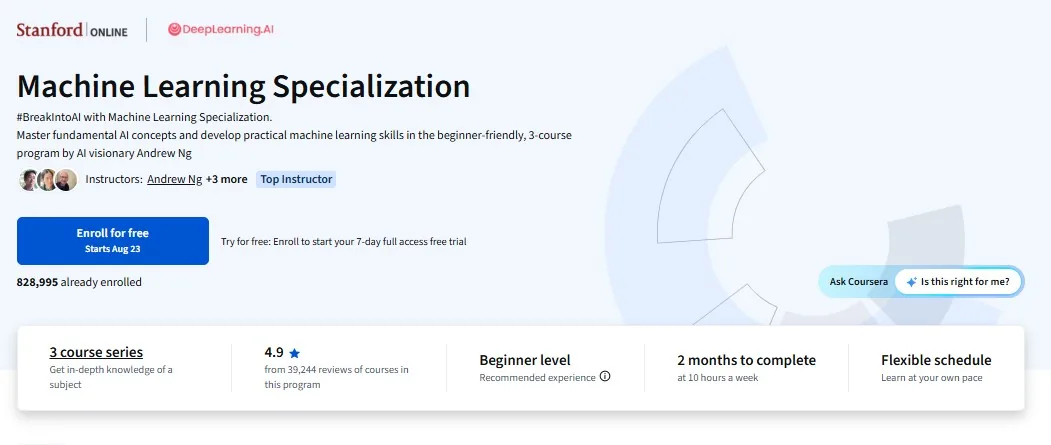
Why we score it 4.6 / 5
Our preference for a structured machine-learning foundation. Its emphasis on underlying methods is useful for learners who want to understand models, while a focused application course may suit an experienced developer seeking a specific tool. Plan for sustained study and Python practice; we have no course-specific completion-rate data.
4.9 / 5 how well it teaches4.3 / 5 what the certificate is worth
Deep Learning Specialization (DeepLearning.AI)
Best for Deep LearningThe gold-standard deep-dive into neural networks, taught by Andrew Ng. It teaches the concepts behind modern AI — CNNs, RNNs, transformers, and more — so you understand what you're building. Highly respected by technical hiring managers.
✓ Pros
- Deep, rigorous coverage of neural networks
- Excellent reputation in the field
- Strong project work
✕ Cons
- Math-heavier than most
- Best after the ML Specialization
Who it's for: Those ready to go beyond the basics into serious deep learning.
Read our full review of Deep Learning Specialization →
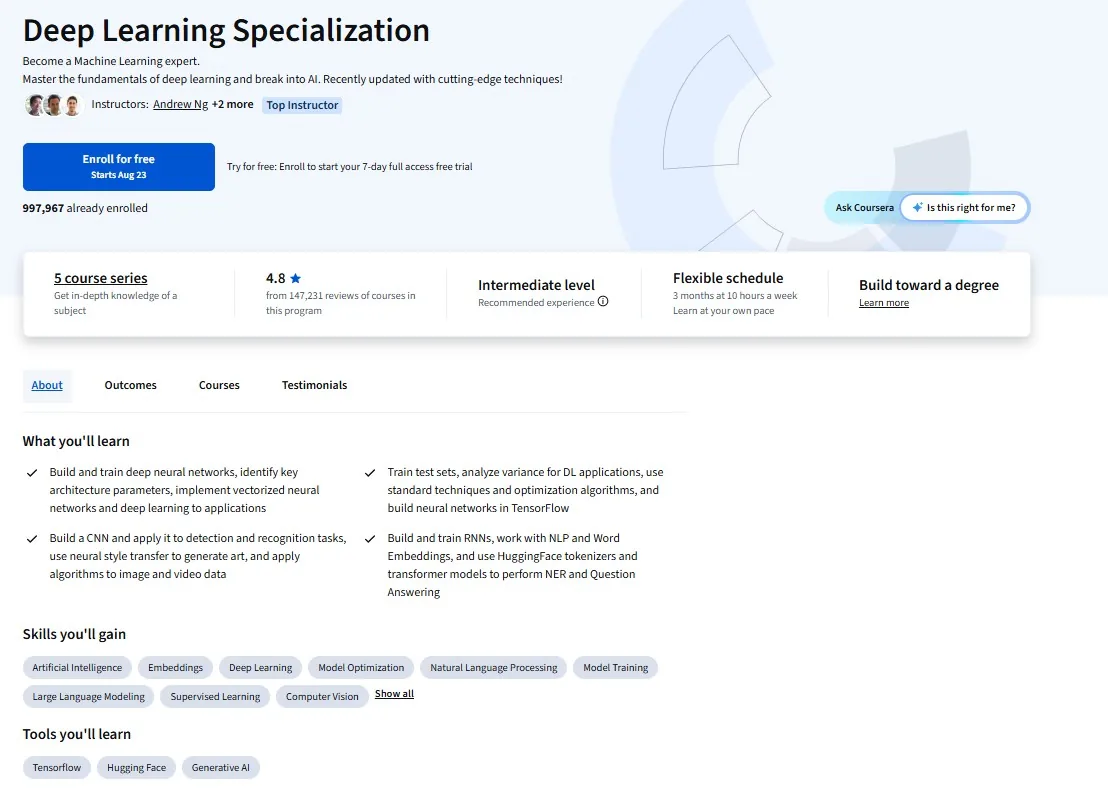
Why we score it 4.5 / 5
A theory-oriented route into neural networks for learners with Python and mathematics foundations. We value its depth; learners who need a short practical introduction may prefer a narrower track. The study commitment is a planning consideration, not a measured probability of finishing.
4.8 / 5 how well it teaches4.2 / 5 what the certificate is worth
IBM AI Engineering Professional Certificate
Best for Aspiring ML EngineersA multi-course program that goes deep into machine learning and deep learning with hands-on projects in Python, using scikit-learn, Keras, and PyTorch. It's a serious step up from awareness-level certificates and builds a portfolio you can show employers.
✓ Pros
- Hands-on, project-based learning
- Builds a real portfolio
- Recognized IBM brand
✕ Cons
- Requires Python comfort
- Multi-month commitment
Who it's for: Career switchers and analysts moving toward ML engineering roles. Read our full IBM AI Engineering review →
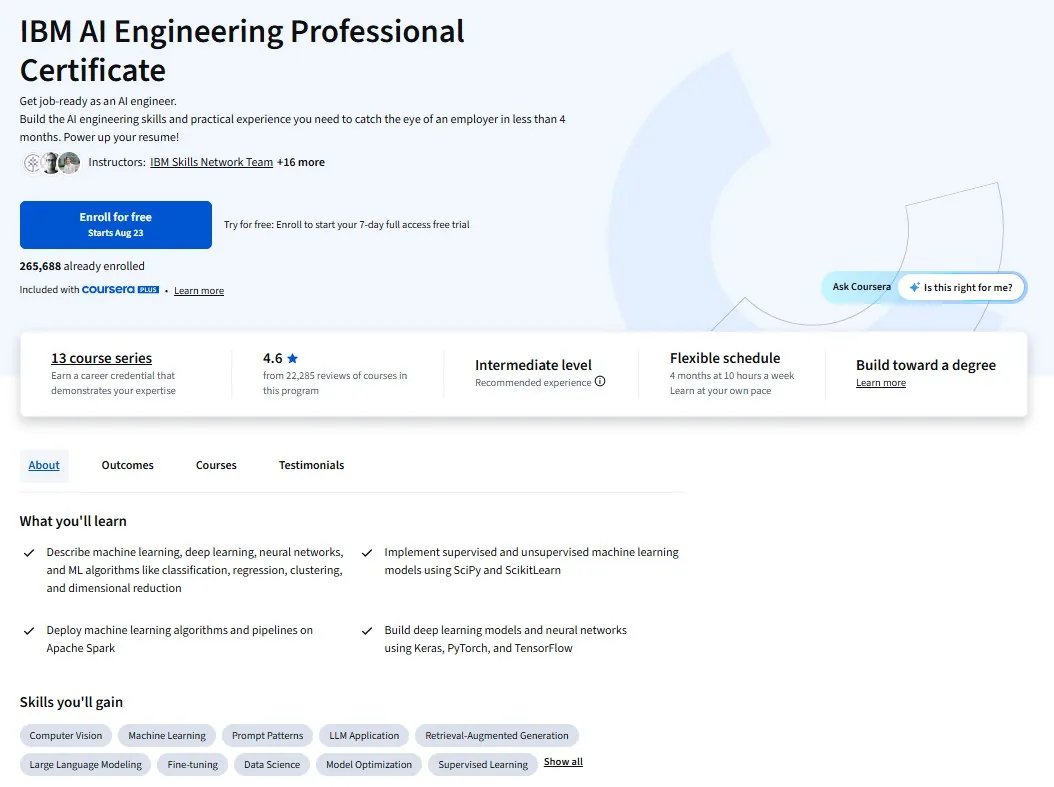
Why we score it 4.5 / 5
A substantial engineering curriculum with Python, Keras and PyTorch. We value the depth but consider the study commitment a limitation for learners seeking a short introduction. We have no evidence that most enrolled learners fail to finish, and the score should not be read as a completion statistic.
4.6 / 5 how well it teaches4.0 / 5 what the certificate is worth
Prompt Engineering Specialization (Vanderbilt)
Best for Working with LLMsPrompt engineering is the highest-leverage AI skill for non-engineers right now. This specialization teaches you to get consistently great output from large language models for writing, research, analysis, and automation — no coding needed.
✓ Pros
- Immediately useful, practical skill
- No coding required
- University-backed credential
✕ Cons
- Narrow focus (by design)
- Fast-moving field
Who it's for: Marketers, writers, analysts, and anyone who works with AI tools daily.
Read our full review of Prompt Engineering (Vanderbilt) →
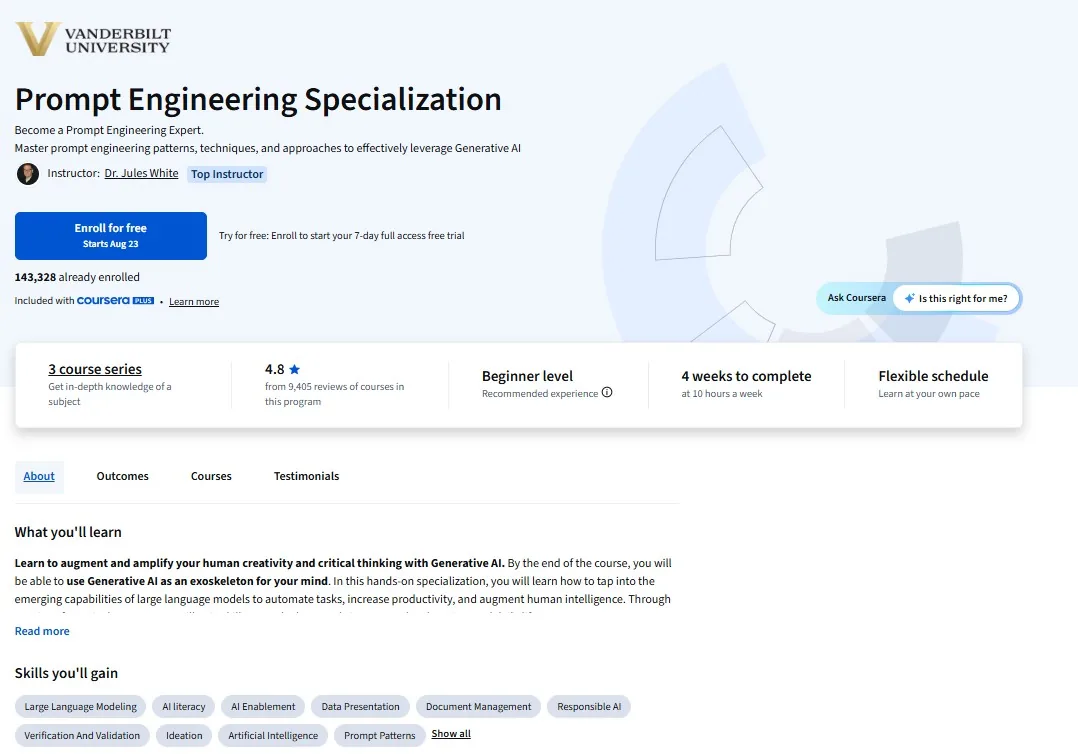
Why we score it 4.5 / 5
A structured approach to prompting for learners who want more than isolated examples. We value its accessibility, while treating its scope as a limitation for anyone needing software engineering, model training or deployment skills. A university-branded course certificate does not guarantee employer recognition.
4.3 / 5 how well it teaches4.0 / 5 what the certificate is worth
Not sure this is the right one for you?
Tell the picker about your background and what you want the certificate to do, and it narrows the list to the one or two courses we would start with. It suggests only our affiliate partners’ courses, and says so before it suggests anything.
Try the AI Certification Picker →Vendor exams we compare but do not score
Every ranked entry above is a taught programme that ends in a completion certificate, and our six factors score a syllabus and whether you will finish it. A proctored vendor exam is a different product: there is no syllabus to finish, no learner ratings to read, and the credential is assessed rather than awarded for turning up. Scoring one on the same scale would be a number we made up, so the exams are named here unscored and compared in full — fees, formats and validity — on AI certification exams.
- AWS Certified AI Practitioner (AIF-C01) — the entry-level exam most readers ask about. Study guide and review.
- Microsoft Azure AI Fundamentals (now exam AI-901) — its Microsoft counterpart. Microsoft retired AI-900 on 30 June 2026, and AI-901 expects basic Python. Study guide, and how it compares with AIF-C01.
- Microsoft Azure AI Apps and Agents Developer Associate (AI-103) — the build-level Azure exam, which replaced the retired AI-102. What replaced AI-102.
- Google Cloud Professional Machine Learning Engineer — the advanced cloud ML exam that the Google Cloud preparation programme in Also strong leads to. Exam guide.
- Google Cloud Generative AI Leader — foundational, for people who buy and govern AI rather than build it. Guide.
- Databricks Certified Generative AI Engineer Associate — guide.
- NVIDIA-Certified Associate: Generative AI LLMs (NCA-GENL) — guide, and the full NVIDIA line-up.
For the AWS entry exam, the practice set we list is on Udemy and bought once. It does not replace the vendor's own exam guide; it is for finding out what you do not know before you pay the exam fee. It is scored 4.0/5 with us. We no longer list an Azure practice set: the one we did was written for AI-900, which Microsoft retired on 30 June 2026.
What changed in AI certifications in 2026?
Mostly the exams: several of the best-known vendor exams were retired this year, most of them with a named successor, which is why a ranking or a study plan from last year can send you to an exam nobody can sit. The list below comes from each vendor’s own retirement notice. AWS is also moving its Machine Learning Engineer Associate exam from MLA-C01 to MLA-C02; our study guide has the switch-over dates. On the course side, the Google AI Professional Certificate now sits beside Google AI Essentials as Google’s longer, eight-course option.
- Microsoft Certified: Azure AI Engineer Associate (AI-102) — retired; Microsoft reports the date as 30 June 2026. Replaced by Microsoft Certified: Azure AI Apps and Agents Developer Associate (AI-103).
- Exam AI-900: Microsoft Azure AI Fundamentals — retired on 30 June 2026. Replaced by Exam AI-901: Microsoft Azure AI Fundamentals, which earns the same Azure AI Fundamentals certification but expects Python and familiarity with REST APIs and SDKs.
- Microsoft Certified: Azure Data Scientist Associate (DP-100) — retired; Microsoft reports the date as 1 June 2026. Replaced by Microsoft Certified: Machine Learning Operations Engineer Associate (AI-300).
- AWS Certified Machine Learning – Specialty (MLS-C01) — retired; the last exam date was 31 March 2026. No replacement named by the vendor; holders stay certified for three years from the date they earned it.
- Salesforce Certified AI Associate — retired in February 2026. Replaced by Agentblazer Status, a Trailhead programme recognising AI and Agentforce skills rather than a proctored exam.
Also strong, and covered in depth elsewhere
Seven credentials sit just outside the ranked twelve. Three left it in September 2026, when we cut the list from fifteen to twelve — they scored lowest of the fifteen, not badly — and four were in the top ten before the August 2026 re-weighting and have not got worse; the field around them got more current. All seven are still worth taking for the right person, and each has a full write-up on this site. Where one is not scored, we say so rather than print a number.
- Preparing for Google Cloud ML Engineer Certification (Google Cloud, 3.7/5, ~19 hrs) — Google’s own preparation for the Professional Machine Learning Engineer exam below. It was ranked twelfth of fifteen as a six-course programme until September 2026; Coursera has since cut it to two courses, on production ML systems and MLOps, and we re-scored it. Our review and the exam guide.
- AI Fundamentals (DataCamp, 4.4/5, ~9 hrs) — nine hours of no-code exercises on what a model is and how it is trained and judged; the typing-rather-than-watching alternative to the Google course below. Ranked on our beginners page.
- Google AI Essentials (Google, 4.3/5, ~6–10 hrs) — still the first stop for most beginners: a recognised name, no coding, finished in a weekend. It scores below the ranked twelve because it is an orientation rather than a syllabus, which is exactly what a beginner needs and not what this ranking weighs. Our review.
- Generative AI for Everyone (DeepLearning.AI, 4.3/5, ~6 hrs) — an excellent six-hour introduction that now overlaps almost completely with Google AI Essentials, above. Taking both is repetition rather than progress. See our generative AI guide.
- Microsoft AI & ML Engineering (4.2/5, ~180 hrs) — still the right choice if your employer runs on Azure, and one of the longest programmes we cover. Compared against the alternatives in our three-way cloud comparison.
- IBM Generative AI Engineering (4.5/5, ~188 hrs) — a thorough route into LLM and RAG work that ties the last three ranked entries on score, but at 188 hours by Coursera's course cards it asks more than six times what Associate AI Engineer for Developers asks to reach a similar place. Weighed up in IBM AI Engineering vs Generative AI Engineering.
- Introduction to AI and Machine Learning (AWS exam prep, not scored, ~9 hrs) — useful exam preparation, but published by LearnKartS rather than by AWS itself, which is not what most people assume when they enrol. Our AWS AI Practitioner review and study guide cover the exam properly.
How to choose the right AI certification
Don't collect certifications — pick the one that matches your goal, then go deep. Here's a simple decision path:
- Complete beginner, any field: Google AI Essentials — fast, cheap, recognized, and in Also strong above. Prefer typing to watching? AI Fundamentals covers the same ground in nine hours of exercises.
- Want to truly understand AI: Machine Learning Specialization from Stanford & DeepLearning.AI — the longest way round, and still the one that teaches the most.
- Aiming to become an ML engineer: IBM AI Engineering or the Deep Learning Specialization.
- You already write Python and need to ship AI features now: Associate AI Engineer for Developers, or Developing AI Applications if you want the shortest route to a working app.
- You already do data science: Associate AI Engineer for Data Scientists — fine-tuning and deployment rather than calling an API.
- Want the hottest GenAI skills: Prompt Engineering from Vanderbilt.
- Experienced and chasing salary: the Google Cloud ML Engineer preparation programme — advanced, in Also strong above, and the one taught route here that ends in a vendor exam.
- Work in a Microsoft or AWS shop: neither vendor's own programme is ranked above; weigh them in our three-way cloud comparison.
- On a budget: see our best free AI certifications guide first.
Certification vs certificate: which one are you buying?
The words are used interchangeably and the products are not. A certificate is issued for completing a course: every ranked entry above ends in one, and a few of them add marked work along the way. A certification is issued for passing an assessment somebody else sets — the vendor exams in the section above, or DataCamp's separately sold associate certification, which is a timed, assessed exam rather than a completion record. Employers read the two differently. A certificate says you covered the material; a certification says you were tested on it. Neither says you can do the job, which is why the strongest thing you can attach to either is a project you built with it. Choose the certificate route to learn the skill, and add the certification when a job description names one.
When you don't need an AI certification
You do not need one if you already have the thing it stands in for. A working engineer with shipped AI features and a repository to show has more evidence than any certificate on this page; a marketer whose campaigns already use these tools has the result, not the badge. You also do not need one to decide whether the field is for you — a free course does that in a weekend, and our free certifications guide lists the ones worth the time. The cases where a certificate earns its cost are narrower than the marketing suggests: you are changing discipline and need a structured path; a recruiter or an internal mobility scheme filters on a named credential; or your employer pays and the hours would otherwise go unstructured. If none of those is you, build something and skip the certificate.
Do AI certifications expire?
Course certificates do not expire, but they date: a certificate that predates retrieval-augmented generation, agents and vector databases is evidence of a syllabus the field has moved past, which is why currency is the first thing this ranking weighs. Vendor certifications are different. Most carry a validity period — two or three years is typical, Microsoft's associate certifications renew every year, and each vendor's figure is recorded on our exams page — after which you re-certify by exam or by a vendor's renewal assessment. Treat both the same way in practice: name the year you earned it, and keep the skill current by using it, because an interviewer will ask about last month's tooling regardless of what the paper says.
Match a certification to your job or situation
The ranking above is general-purpose. If you want picks weighed against a specific role or starting point, these companion guides go deeper:
By profession: software engineers, data analysts, data engineers, product managers, project managers, marketers, healthcare, finance, cybersecurity, lawyers, HR, executives and teachers.
By situation: complete beginners, no coding required, a career change, no degree, the fastest to finish, under $100, or the best AI courses for learning, the best AI courses on Udemy, the ChatGPT certification question, or use our decision guide.
Still deciding between two options?
Read our head-to-head: Google AI Essentials vs. the IBM AI certificate.
Compare Them →Go deeper: guides for your role, situation and exam
The ranking above is deliberately general. If one of these describes you more precisely, start there instead — each is a full guide rather than a paragraph.
Ready to start?
Bought once, with what Udemy calls lifetime access. Udemy's price swings between its list price and a sale price, sometimes within days — check it on the day rather than trusting any figure you read, here or anywhere else.
Frequently asked questions
What is the best AI certification in 2026?
There is no single winner, because the honest answer depends on what you already know. Two programmes share the top score of 4.9/5: the AI Engineer Core Track on Udemy, thirty-three hours on retrieval, QLoRA fine-tuning and multi-agent systems, bought once; and DataCamp's Associate AI Engineer for Developers, twenty-nine hours on the OpenAI API, embeddings, vector databases, LangChain and MCP, on a subscription. Both assume you already write Python.
For most beginners the answer is Google AI Essentials — six to ten hours, no coding, and a brand every recruiter recognises, which is why it rates 4.3/5 here. For a rigorous foundation it is the Machine Learning Specialization from Stanford and DeepLearning.AI, at 4.6/5 still the deepest teaching of the fundamentals we review, at about ninety-five hours.
The thing that decides it is not the ranking. Pick the one that matches the role you want and finish it — one completed credential beats three abandoned ones, and abandonment is the normal outcome when people choose on prestige instead of fit.
Are AI certifications worth it in 2026?
For most people, yes — with a clear limit. A recognized certification will not replace hands-on experience and no certificate on its own gets you hired. What it does is help you pass résumé screens, signal that you understand core concepts and tools, and give you a structured syllabus when you do not yet know what to learn next.
The value is highest for two groups: beginners who need a path, and career switchers who need something verifiable to point at. It is lowest for experienced engineers, who are generally better served by shipping something than by certifying what they can already do.
The best return comes from certifications tied to platforms employers actually run — Google, Microsoft, AWS and IBM — because the skills transfer to a job posting rather than to a syllabus. We set out the full case both ways in are AI certifications worth it?
Which AI certification is best for beginners?
Google AI Essentials, for most people. It needs no coding and no mathematics, runs six to ten hours, and carries a name that is recognised on sight — which matters more at the start than depth does, because the first credential's job is to get you moving and give you something to show.
If you want something deeper while still beginner-friendly, the Machine Learning Specialization from Stanford and DeepLearning.AI is exceptional. Andrew Ng teaches intuition before mathematics and it starts from first principles rather than assuming prior machine-learning knowledge, but it does use Python and runs about ninety-five hours, so it is a foundation rather than a quick credential.
If cost is the constraint rather than the level, start with the free options — several issue a shareable badge at no cost. Our full beginner guide compares seven picks in detail.
How much do AI certifications cost?
Course certificates cost what the platform charges while you study: a Coursera Plus or DataCamp Premium subscription, both priced by country and cheaper per month billed annually, or a one-off Udemy purchase whose price swings day to day. The Coursera courses, specializations and professional certificates on this list are typically covered by a Coursera Plus subscription, which Coursera prices differently by country — so what you pay depends on your region and on how fast you finish, not on a single list price. Google AI Essentials is $49 a month in the US and Canada after a seven-day trial, or included if you already hold Plus.
Proctored vendor exams are the exception and are priced separately from any course. The AWS AI Practitioner exam runs about $100.
You can also pay less, or nothing. Most Coursera courses let you preview the first module free, and select ones offer a free "Full Course, No Certificate" option — check the course page — while Coursera runs a financial aid programme that takes a discount off a course's fee once approved, and there are strong genuinely free options.
Do AI certifications increase your salary?
Sometimes, and less directly than the marketing suggests. We rate salary impact as one of our six scoring factors, and the pattern is consistent: advanced credentials that map to production machine learning work — the Google Cloud ML Engineer track, the deeper specializations — are the ones associated with higher pay, because they certify work that is genuinely scarce.
Entry-level certificates behave differently. They help you land interviews far more than they raise an offer, and that is still valuable: an interview you would not otherwise have got is worth more than a few percent on a salary you were never offered.
We do not publish a figure for the increase, because we have not verified one we would stand behind. Anyone quoting a precise salary uplift for a specific certificate is estimating. Treat the credential as access to the conversation, and let the work you can demonstrate set the number.
Can I put AI certifications on my résumé and LinkedIn?
Yes. Every paid certificate on this list comes with a shareable credential you can add to LinkedIn's Licenses & Certifications section and to your résumé, with a verification link the reader can actually check. Use that link every time — an entry that can be verified is worth several that cannot.
Be selective about how many. Two or three recognized credentials plus one real project reads as direction; a long list of badges reads as padding, and reviewers tend to discount the whole list rather than pick the good ones out of it. Order them by relevance to the job you want next, not by the date you earned them.
Free credentials belong there too, with the same rule applied — several of the free options issue a verifiable badge, and a recognised free badge beats an unverifiable paid one.
Are these AI courses or certifications?
Both, and that is exactly why they are on this list. Every pick here is an online course — or a multi-course specialization — that also awards a shareable certificate on completion. The two words get searched as if they were different products, but for these providers they describe the same thing from two ends: what you do, and what you are left holding.
So whether you are looking for the best AI course to actually learn from, or the best AI certification to put on a CV, these are the same options. The one distinction worth keeping is vendor exams: a proctored certification exam such as AWS AI Practitioner tests you without teaching you, and the course that prepares you for it is a separate purchase.
If you want learning-first picks including free ones, see our best AI courses guide.
Certification vs certificate: which one are you buying?
A certificate is issued for completing a course, and every ranked entry on this page ends in one. A certification is issued for passing an assessment somebody else sets: the vendor exams we list unscored, or DataCamp’s separately sold associate certification, which is a timed exam rather than a completion record. Employers read them differently — a certificate says you covered the material, a certification says you were tested on it — and neither proves you can do the job. Take the certificate route to learn the skill, and add a certification when a job description names one.
When don't you need an AI certification?
When you already have the thing it stands in for. Shipped AI features and a repository are stronger evidence than any certificate here; so are campaigns or analyses that already use these tools. You also do not need one to find out whether the field is for you — a free course does that in a weekend. A certificate earns its cost when you are changing discipline and need a structured path, when a recruiter or an internal scheme filters on a named credential, or when your employer pays for it. Otherwise, build something and skip it.
Do AI certifications expire?
Course certificates do not expire, but they date: one that predates retrieval, agents and vector databases is evidence of a syllabus the field has moved past, which is why currency is the first factor this ranking weighs. Vendor certifications usually carry a validity period, typically two or three years, after which you re-certify by exam or a renewal assessment; each vendor’s figure is recorded on our exams page. Either way, name the year you earned it and keep the skill current by using it.
Updated September 2026. Eight Udemy courses re-scored after weighing their learner-review evidence (tens of thousands of ratings each, checked in a browser), and an unassessed completion certificate now scores the same whichever provider issues it. The AI Engineer Core Track moves from eighth to joint first; the comparison table gains an enrol button per row. Each entry’s “Why we score it” explains the change.