Amber enrol buttons are DataCamp and Udemy affiliate links; we earn a commission if you enrol through them. How we're funded.
Quick answer
The AWS Certified AI Practitioner (exam code AIF-C01) is worth it if you're building a cloud or AWS-centric career — it's AWS's foundational, no-code AI exam: 65 questions in 90 minutes, which AWS lists at 100 USD. Prepare in two steps: learn the syllabus first, with AWS Skill Builder's free exam prep or a structured course, then sit full-length practice exams until you pass them comfortably before you pay to book. Budget roughly 20–30 hours of study.
Exam AI-900: Microsoft Azure AI Fundamentals is retired. The replacement is Exam AI-901: Microsoft Azure AI Fundamentals, which earns the same Azure AI Fundamentals certification but expects Python and familiarity with REST APIs and SDKs.
Where we would start on DataCamp or Udemy
We choose these picks only among our affiliate partners’ courses (365 Data Science, DataCamp and Udemy). Our full ranking also includes courses that earn us nothing.
If you want the AI concepts taught before you touch AWS's service names: nine no-code hours on machine learning, large language models and generative AI, graded in the browser. It covers the conceptual ground of the exam's first two domains, not AWS's own services.
Why this course, and its limitations
A non-coding introduction to machine-learning concepts, LLMs, generative AI and ethics. We value it as a literacy route, not an engineering qualification. Choose it for the learning format and topics; we have no evidence quantifying its value in hiring.
Learning: 4.3/5. Credential: 2.8/5. These are separate editorial judgments, not learner ratings or job-placement statistics.
The taught course that pairs with the practice set above: about ten hours on the exam's AI concepts and AWS's own services, from the same instructor. Learn first with this, then use the question bank to check you are ready.
Why this course, and its limitations
A taught course for the AWS Certified AI Practitioner exam, bought once, needing no AWS, IT or AI background, with a section each on Bedrock, Amazon Q and SageMaker. We value its current generative-AI syllabus at a finishable length. It is conceptual by design, and its one practice exam is a first check, not proof of readiness. The certificate is an unassessed completion record; only AWS's exam awards the credential. Learner evidence, read on Udemy on 25 September 2026: 52,488 ratings averaging 4.7 from 285,526 learners, and a syllabus updated 2026-09.
Learning: 4.3/5. Credential: 3.2/5. These are separate editorial judgments, not learner ratings or job-placement statistics.
The step most candidates skip, and the one that protects the exam fee: four full practice exams, 260 questions. It is a question bank with no video — learn the syllabus first, then use it to find out whether you are ready to book.
Why this course, and its limitations
A practice-question bank for AWS AI Practitioner preparation. We value it as a way to identify gaps after studying the exam topics. Practice results do not guarantee an exam pass, and this is not a full teaching course.
Learning: 2.5/5. Credential: 3.2/5. These are separate editorial judgments, not learner ratings or job-placement statistics.
The AWS Certified AI Practitioner is Amazon's foundational AI credential — and because AWS dominates the cloud market, it carries real weight in cloud-AI hiring. It validates that you understand AI, machine learning, and generative AI in the context of AWS, without requiring you to code. Here's whether it's worth it, and the best way to prepare.
What is the AWS AI Practitioner certification?
It's an entry-level AWS certification (exam code AIF-C01) covering the fundamentals of AI and ML, generative AI concepts, responsible-AI practices, and how AWS's AI services fit together. It's aimed at people who work with or around AI on AWS — not just engineers, but also analysts, product managers, sales engineers, and decision-makers in AWS shops. Unlike AWS's associate- and professional-level certifications, it assumes no hands-on ML engineering experience, so it's a realistic first step for someone who understands the business of AI but doesn't build models day to day.
Because it's vendor-specific, the value is highest when your target roles live inside the AWS ecosystem. If you're not sure you want to commit to one cloud yet, a vendor-neutral starting point like Google AI Essentials may serve you better first — we compare the two below.
What you'll be tested on
AWS organizes the exam into a handful of knowledge domains. At a high level you're expected to understand:
- Fundamentals of AI and ML — core terminology, common use cases, and the difference between AI, machine learning, and deep learning.
- Fundamentals of generative AI — how foundation models and large language models work at a conceptual level, and where they fit on AWS (for example, Amazon Bedrock and Amazon Q).
- Applications of foundation models — prompt design, retrieval-augmented generation, fine-tuning trade-offs, and how to evaluate model outputs.
- Responsible AI — fairness, bias, transparency, and the guardrails that make AI systems safe to deploy.
- Security, compliance, and governance — how to keep data and AI workloads secure and compliant on AWS.
AWS periodically re-weights these domains, so check the current official exam guide for the exact breakdown before you sit the test. The important takeaway: it's conceptual and no-code, so you're being tested on understanding rather than programming.
The best way to prepare
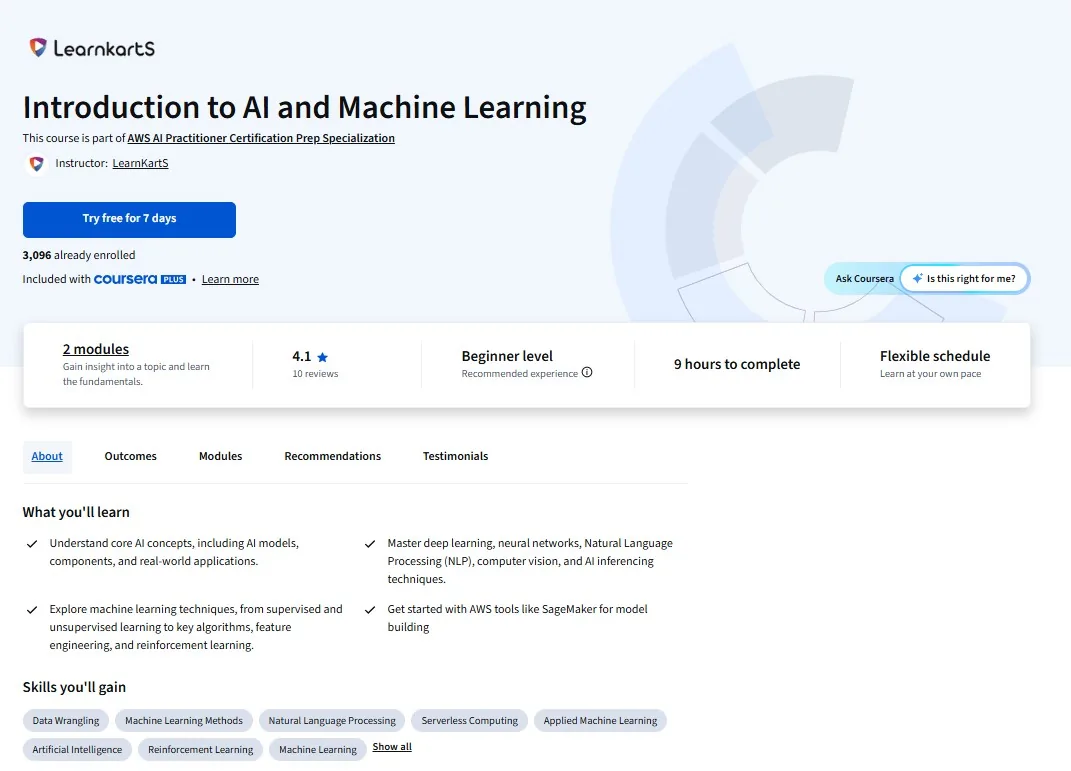
Preparation has two jobs, and most people only do the first. Learning the syllabus is the first: AWS Skill Builder's exam-prep material is free and written by AWS, and if you prefer a structured course, the "Introduction to AI and Machine Learning" course on Coursera — published by LearnKartS rather than AWS itself — maps to the exam objectives, needs no coding and is included with a Coursera Plus subscription. It is a young course, though, with only a handful of learner ratings so far.
Proving you're ready is the second, and it is what protects the exam fee. Full-length practice exams show you whether the material stuck and which domains need another pass. The set we would use is Udemy's AWS Certified AI Practitioner AIF-C01 Practice Exams: four full exams, 260 questions, bought once, with no video — a check on your study, not a substitute for it. It is recommended at the top of this page, and our AWS AI Practitioner study guide sets out a week-by-week plan around it.
A study plan that works well for most people: work through the syllabus once, sit a first practice exam to find your gaps, close them, and book the real exam when you pass the remaining practice exams comfortably. Because the exam leans conceptual, spaced repetition of terminology and AWS service names pays off more than deep technical drilling. Most candidates are ready after 20–30 hours spread over two to four weeks.
Exam details
The table below shows the fee and format of AIF-C01, as AWS publishes them. Every other exam we track is compared on our AI certification exams page.
| Credential | Vendor | Level | Fee | Exam format | Enrol |
|---|---|---|---|---|---|
| AWS Certified AI Practitioner (AIF-C01) | AWS | Foundational | 100 USD | 90 minutes · 65 questions | AWS → |
The exam is a proctored multiple-choice and multiple-response test you can take online or at a test center. No coding is required, but structured prep makes a big difference. AWS lists it as 65 questions in 90 minutes for 100 USD, and points to a separate exam-pricing page for foreign exchange rates; these terms change over time, so confirm the current details on AWS's certification page before you book.
Udemy also sells this exam as a voucher you use when you book (its AWS Certified AI Practitioner voucher page), and says booking through it saves at least 10%. By Udemy’s own terms the voucher is valid for at least nine months from purchase, works only in the country you buy it in, is not sold in every country and cannot be refunded; if AWS retires the exam before the voucher expires, the voucher may become invalid. Buy it when you have a booking date in mind, not at the start of your prep.
How it compares to alternatives
The AWS AI Practitioner isn't the only foundational AI credential. Here's how it stacks up against the two most common alternatives people weigh against it:
The table below compares 6 credentials on best for, coding, format and typical cost.
| Credential | Best for | Coding | Format | Typical cost | Enrol |
|---|---|---|---|---|---|
| AWS Certified AI Practitioner AIF-C01 Practice Exams | Rehearsing AIF-C01 questions before you book the exam | — | Udemy practice exams | Paid, one-off | Udemy → |
| AI Fundamentals | The concepts the exam tests, without the exam | No | DataCamp track | Paid, subscription | DataCamp → |
| Ultimate AWS Certified AI Practitioner AIF-C01 | Learning the AIF-C01 syllabus on video before the practice papers | No | Udemy course | Paid, one-off | Udemy → |
| AWS AI Practitioner | Cloud / AWS-centric careers | None | Proctored exam | ~$100 exam | |
| Google AI Essentials | Vendor-neutral first step for any role | None | Self-paced course | Coursera subscription | Coursera → |
| Machine Learning Specialization | A deeper, technical ML foundation | Yes (Python) | Self-paced specialization | Coursera subscription | Coursera → |
If your target roles specifically mention AWS, the AI Practitioner is the most direct signal. If you want portability across employers and clouds, start vendor-neutral. And if you eventually want to build models rather than just understand them, plan to follow this with a hands-on program. See our full AWS vs Azure vs Google AI certifications comparison for the bigger picture.
AWS AI Practitioner vs Azure AI-900
The question we get most often is how the AWS AI Practitioner compares to Microsoft's equivalent, the Azure AI Fundamentals certification. Both are foundational, single-exam credentials aimed at people who want to prove AI literacy on a major cloud — but Microsoft retired the AI-900 exam on 30 June 2026, and its replacement, AI-901, expects basic Python where the AWS exam asks for no coding at all. The right one is almost always decided by which cloud your employer (or target employer) actually runs.
The table below compares AWS AI Practitioner and Azure AI Fundamentals (now exam AI-901) on six dimensions.
| AWS AI Practitioner | Azure AI Fundamentals (AI-901) | |
|---|---|---|
| Cloud ecosystem | Amazon Web Services | Microsoft Azure |
| Level | Foundational | Foundational |
| Coding required | None | Basic Python (exam now AI-901) |
| Format | Proctored exam | Proctored exam |
| Typical exam cost | ~$100 | ~$100 |
| Best if you target… | AWS-centric roles | Microsoft/Azure shops |
They used to be near-mirror images: affordable, exam-based and foundational. Now the Microsoft exam (AI-901) also expects basic Python and puts more than half its weight on building in Microsoft Foundry, so for a non-programmer the AWS exam is the gentler of the two. Beyond that, the practical differences are the platform vocabulary you'll learn (Amazon Bedrock, SageMaker, and Amazon Q on the AWS side; Azure AI services and Azure Machine Learning on the Microsoft side) and, more importantly, employer demand in your market. If job listings you're targeting name AWS, take the AI Practitioner; if they name Azure, take Azure AI Fundamentals (AI-901). If you have no strong lean either way, AWS's larger cloud market share means the AI Practitioner is the safer default. For the full three-way picture, see our AWS vs Azure vs Google AI certifications comparison.
How hard is it?
For a foundational exam, it's approachable. There's no coding and no live console work — it's conceptual multiple choice. The most common reason people underestimate it is the generative-AI and responsible-AI content, which is newer and uses AWS-specific service names (Bedrock, SageMaker, Amazon Q) that you need to recognize. If you've done any general AI course and then work through that prep course, most candidates find the difficulty fair. Complete beginners should simply budget a little more time on the terminology.
Salary and career impact
Be realistic about what a foundational credential does: on its own, the AWS AI Practitioner is a door-opener, not a salary lever. It won't move your pay the way a senior, hands-on credential like the Google Cloud ML Engineer track can, because it validates literacy rather than the ability to build and ship models. What it does well is help you clear résumé and applicant-tracking screens for cloud, data, solutions-architecture, and technical-sales roles where "AWS" and "AI/ML" both appear in the job description — and it signals initiative to a hiring manager.
The bigger career payoff comes from using it as the first rung on an AWS ladder. Pair it with hands-on projects and follow it, when you're ready, with an associate-level certification such as AWS's Machine Learning Engineer – Associate (the older Machine Learning – Specialty exam was retired on 31 March 2026); that combination — foundational credential, real projects, then a deeper cert — is what actually correlates with better roles and pay. Treat the AI Practitioner as the on-ramp, not the destination.
Pros and cons
✓ What we liked
- AWS is the most in-demand cloud platform
- Appears frequently in cloud-AI job postings
- No coding required
- Third-party exam prep available on Coursera
✕ What to keep in mind
- Heavily AWS-specific
- Requires passing a separate proctored exam
- Foundational rather than deeply technical
Who should pursue it
Pursue it if you're building a career in or around the AWS ecosystem and want a recognized AI credential that hiring managers see often — cloud engineers, solutions architects, data analysts, product managers, and technical sales roles at AWS-centric companies all benefit. It's also a sensible first rung before AWS's more advanced associate-level certifications, such as Machine Learning Engineer – Associate.
Skip it if your target roles aren't AWS-centric, you want a vendor-neutral first credential (try Google AI Essentials), or you're an engineer who wants to actually build models rather than certify literacy — in that case a hands-on, code-first program like the Machine Learning Specialization is a better use of your time. It's also the wrong pick if you're chasing an immediate salary bump; a foundational exam won't deliver that on its own (see salary and career impact above).
Not sure this is the right one for you?
Tell the picker about your background and what you want the certificate to do, and it narrows the list to the one or two courses we would start with. It suggests only our affiliate partners’ courses, and says so before it suggests anything.
Try the AI Certification Picker →Is the AWS AI Practitioner worth it?
For cloud-focused careers, yes. The AWS brand and its market dominance make this credential a practical, recognized signal, and it is one of the few proctored AI exams that needs no coding. Learn the syllabus with AWS's free material or a structured course, then prove you're ready on full-length practice exams before you pay to sit it.
Ready to start?
Included in a DataCamp subscription rather than bought outright. DataCamp's pricing page shows the plans and the price for your country, and one subscription covers the rest of its catalogue too.
Frequently asked questions
Is the AWS AI Practitioner worth it?
Yes, if your target roles live inside the AWS ecosystem — and much less so if they do not. It is a foundational, no-code credential (exam code AIF-C01) that validates you understand AI, machine learning and generative AI in an AWS context, and because AWS holds the largest share of the cloud market it appears often in cloud-AI job postings.
The honest limitation is that it is vendor-specific. A certificate in Amazon's vocabulary is worth most where Amazon's services are actually run, and worth noticeably less to an employer on Azure or Google Cloud. If you are not yet committed to one cloud, a vendor-neutral first step such as Google AI Essentials travels further. If the job adverts you are reading name AWS, this is the most direct signal you can send for about $100 and a few weeks of study.
What is the best way to prepare for the AWS AI Practitioner?
In two steps: learn the syllabus, then prove you are ready. For the first, AWS Skill Builder's exam-prep material is free and written by AWS; if you prefer a structured course, LearnKartS's "Introduction to AI and Machine Learning" on Coursera maps to the exam objectives, needs no coding and is included with a Coursera Plus subscription, though it has only a handful of learner ratings so far.
For the second, sit full-length practice exams. The set we would use is Udemy's AWS Certified AI Practitioner AIF-C01 Practice Exams: four full exams and 260 questions, bought once, with no video. Sit the first to find your gaps, close them, and book the real exam when you pass the rest comfortably.
Because the exam is conceptual, spaced repetition of terminology and AWS service names — Bedrock, SageMaker, Amazon Q — pays off more than deep technical drilling. Our study guide turns that into a week-by-week plan.
How much does the AWS AI Practitioner cost?
AWS lists the AWS Certified AI Practitioner exam at 100 USD, and that fee is separate from anything you use to prepare. AWS also points to a separate exam-pricing page for foreign exchange rates, so confirm the figure for your country on AWS's own certification page before you budget.
Preparation can cost nothing: AWS Skill Builder's exam-prep material is free. A structured course such as LearnKartS's on Coursera comes with a Coursera Plus subscription, and a set of full practice exams is a one-off Udemy purchase whose price moves with Udemy's sales, so check it on the day.
The practice exams are the cheapest insurance on the exam fee: a failed attempt costs the full fee again, and finding your gaps on a practice paper first is how most people avoid paying twice.
Do I need coding experience for the AWS AI Practitioner?
No. The AI Practitioner is deliberately conceptual: multiple-choice and multiple-response questions, no coding, and no live console tasks. It assumes no hands-on ML engineering experience, which is what separates it from AWS's associate- and professional-level certifications and makes it a realistic first step for analysts, product managers, sales engineers and decision-makers as well as developers.
What it does assume is familiarity with the vocabulary. You need to recognise AWS service names and explain what they are for, understand how foundation models and retrieval-augmented generation work at a conceptual level, and speak sensibly about fairness, bias and governance. If you want a code-first program instead, the Machine Learning Specialization teaches you to build the models this exam only asks you to describe.
How hard is the AWS AI Practitioner exam?
For a foundational exam it is approachable. There is no coding and no console work, the questions are conceptual, and a candidate who works through a mapped prep course should find the difficulty fair. It is not a formality either — people who walk in on general AI knowledge alone tend to be caught out.
Two areas account for most of that. The generative-AI content is newer than the rest of the syllabus, so older study material covers it thinly, and the responsible-AI domain asks about governance concepts that are easy to nod along to and hard to answer precisely. Both are wrapped in AWS-specific naming — Bedrock, SageMaker, Amazon Q — that you have to recognise on sight. Complete beginners should budget extra time on terminology rather than on theory; the concepts are the accessible part.
Is the AWS AI Practitioner better than Azure AI-900?
Neither is better in the abstract, but they are no longer near-mirror images. Both are foundational single-exam credentials aimed at proving AI literacy on a major cloud (AWS lists 100 USD; Microsoft prices its exam by country). The difference since 30 June 2026 is that Microsoft replaced AI-900 with AI-901, which expects basic Python and puts more than half its weight on building in Microsoft Foundry, while the AWS exam still puts coding out of scope. What differs is the vocabulary you come away with: Bedrock, SageMaker and Amazon Q on the AWS side, Azure AI services and Azure Machine Learning on Microsoft's.
So for a non-programmer the AWS exam is the gentler route. Beyond that, read the job adverts you are actually targeting: if they name AWS, take the AI Practitioner; if they name Azure, take Azure AI Fundamentals (AI-901). A foundational vendor credential is worth what the local market pays for that vendor, and nothing else about it moves that. With no strong lean either way, AWS's larger cloud market share makes the AI Practitioner the safer default — see our three-way cloud comparison for the full picture.
How long does it take to prepare for the AWS AI Practitioner?
Our working estimate is roughly 20 to 30 hours of study, spread over two to four weeks; AWS publishes no figure. That assumes the standard route: the syllabus once, through AWS Skill Builder's free material or a structured course, then a full-length practice exam to find the gaps, then a second pass over whatever the practice exam exposed.
Where people land in that range depends on background rather than ability. If you already work around AWS, much of the study is recognising names for things you have seen, and the lower end is realistic. If AWS is new to you, add time for the service vocabulary specifically — it is the part that does not compress, because there is no way to reason your way to which Amazon product does what. Spreading the hours over weeks beats cramming them into a weekend here: the exam rewards recall of terminology, and recall is what spacing improves.
Does the AWS AI Practitioner certification expire?
Yes. AWS certifications are generally valid for three years, after which you recertify to keep the credential current. AWS sets and occasionally revises the terms, so check its recertification policy for what applies at the time you certify rather than assuming the three-year figure will still hold when yours comes due.
This is worth factoring into the decision, because it is the main structural difference between a vendor exam and a course certificate. The Coursera specializations and professional certificates we review do not expire — once earned, they stay on your profile. A vendor credential is a recurring commitment of both money and time, which is fine when you work in that ecosystem and the certificate is doing a job, and quietly wasteful once you have moved on. Our cost breakdown covers what renewal actually involves.
What is the benefit of the AWS AI Practitioner certification?
It gives you a recognised, vendor-backed signal that you understand AI, machine learning and generative AI in an AWS context, without needing to write code. Practically, that does three things: it clears résumé and applicant-tracking filters for cloud, data, solutions-architecture and technical-sales roles where AWS and AI/ML both appear in the description; it signals initiative to a hiring manager; and it gives non-engineers the vocabulary to discuss AI credibly on the cloud their company already runs.
Be equally clear about what it is not. It validates literacy rather than the ability to build and ship models, so on its own it is a door-opener rather than a salary lever. The payoff comes from using it as the first rung: foundational credential, then real projects, then a deeper certification when you are ready. That combination is what correlates with better roles — the certificate alone is not.
Which AWS certification is best for AI?
For AI specifically, the AWS Certified AI Practitioner is the right starting point: it is the foundational, no-code AI credential, AWS lists it at 100 USD, and it covers generative AI and responsible AI alongside the basics. If you are a hands-on engineer already building and deploying models, the AWS Certified Machine Learning Engineer – Associate is the deeper technical option and a far heavier commitment (its exam version is MLA-C02, which replaces MLA-C01); the older Machine Learning – Specialty was retired on 31 March 2026.
The mistake to avoid is skipping ahead because a harder exam sounds more impressive. The associate exam assumes you have built and deployed ML workloads, and certifying ahead of the work rarely converts into either a job or pay — an advanced credential you scraped through is easy for an interviewer to see past. Most people should take the AI Practitioner, build something real on AWS with what it taught them, and move up only once they are writing production machine-learning code day to day.
Updated July 2026. Expanded with exam domains, an alternatives table, a dedicated Azure AI-900 comparison, salary and career impact, a who-should-skip section, and an updated FAQ.