Amber enrol buttons are DataCamp and Udemy affiliate links; we earn a commission if you enrol through them. How we're funded.
Quick answer
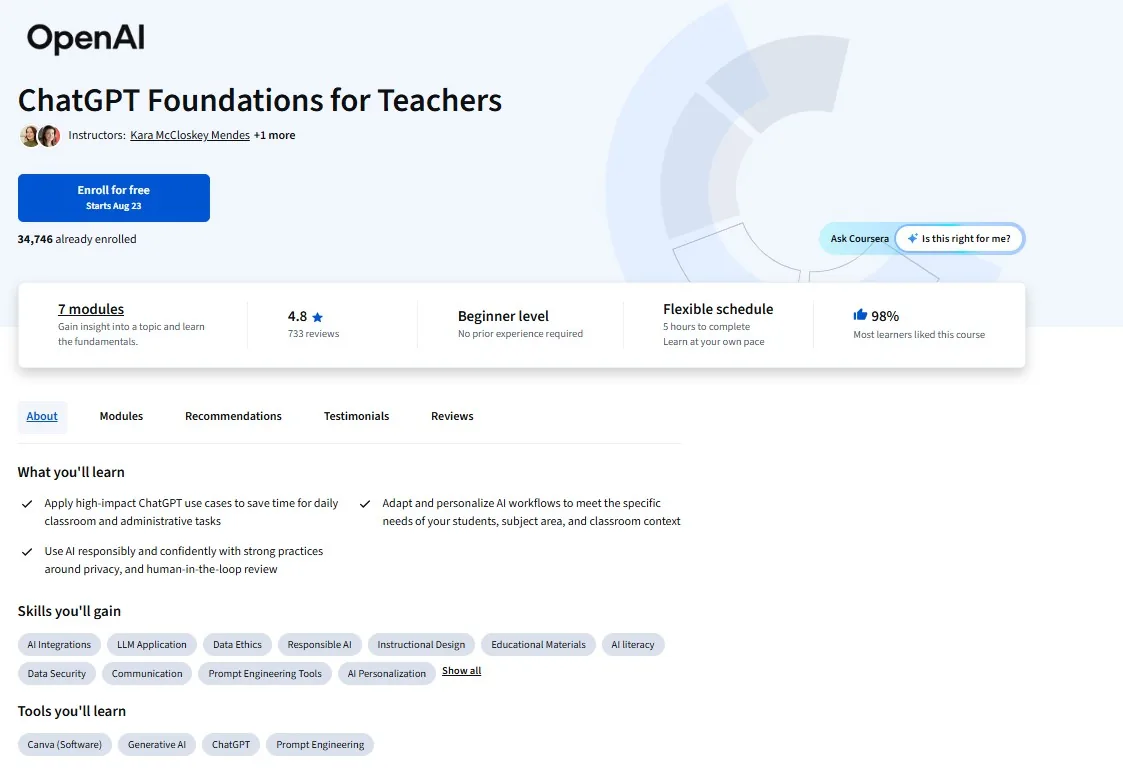
ChatGPT Foundations for Teachers is the best place for most classroom teachers to start: built for educators by OpenAI and Common Sense Media, free on Coursera and no coding — but Coursera states that it awards no certificate, so if you need one to show, take one of the courses below as well. For classroom tools beyond ChatGPT, AI for Teachers: ChatGPT, Lesson Planning & Classroom AI on Udemy is bought once and covers MagicSchool, Brisk, Diffit and NotebookLM; DataCamp’s AI Fundamentals track, on a subscription, is the broader grounding. None of these is a teaching credential. Elements of AI and Microsoft Learn cover the foundations free.
Where we would start on DataCamp or Udemy
We choose these picks only among our affiliate partners’ courses (365 Data Science, DataCamp and Udemy). Our full ranking also includes courses that earn us nothing.
Nine hours of PD time, no coding, and it gives real attention to how models fail — which is the part a teacher needs most, because the failure mode arrives inside a pupil's homework rather than inside a demo.
Why this course, and its limitations
A non-coding introduction to machine-learning concepts, LLMs, generative AI and ethics. We value it as a literacy route, not an engineering qualification. Choose it for the learning format and topics; we have no evidence quantifying its value in hiring.
Learning: 4.3/5. Credential: 2.8/5. These are separate editorial judgments, not learner ratings or job-placement statistics.
Classroom-ready tools rather than theory: ChatGPT, MagicSchool, Brisk, Diffit and NotebookLM, with the NotebookLM section updated March 2026.
Why this course, and its limitations
A no-coding tour of classroom AI tools, bought once: ChatGPT, MagicSchool, Brisk, Diffit and NotebookLM, with side sections on presentations, video and music. We value tools a teacher can apply directly to lesson preparation. Fourteen sections in under six hours leave each tool little depth, and three section titles carry 2025 dates. It is not a teaching credential; the certificate is an unassessed completion record.
Learning: 3.7/5. Credential: 1.5/5. These are separate editorial judgments, not learner ratings or job-placement statistics.
The table below compares 7 certifications on provider, level, realistic time, coding needed and best for.
| Certification | Provider | Level | Realistic time | Coding needed | Best for | Enrol |
|---|---|---|---|---|---|---|
| AI for Teachers: ChatGPT, Lesson Planning & Classroom AI | Udemy | Beginner | ~5.7 hours | No | Classroom tool workflows | Udemy → |
| AI Fundamentals | DataCamp | Beginner | ~9 hours | No | Broader AI grounding | DataCamp → |
| ChatGPT Foundations for Teachers | OpenAI (with Common Sense Media) | Beginner | ~5 hours | No | Classroom ChatGPT use; free, but issues no certificate | Coursera → |
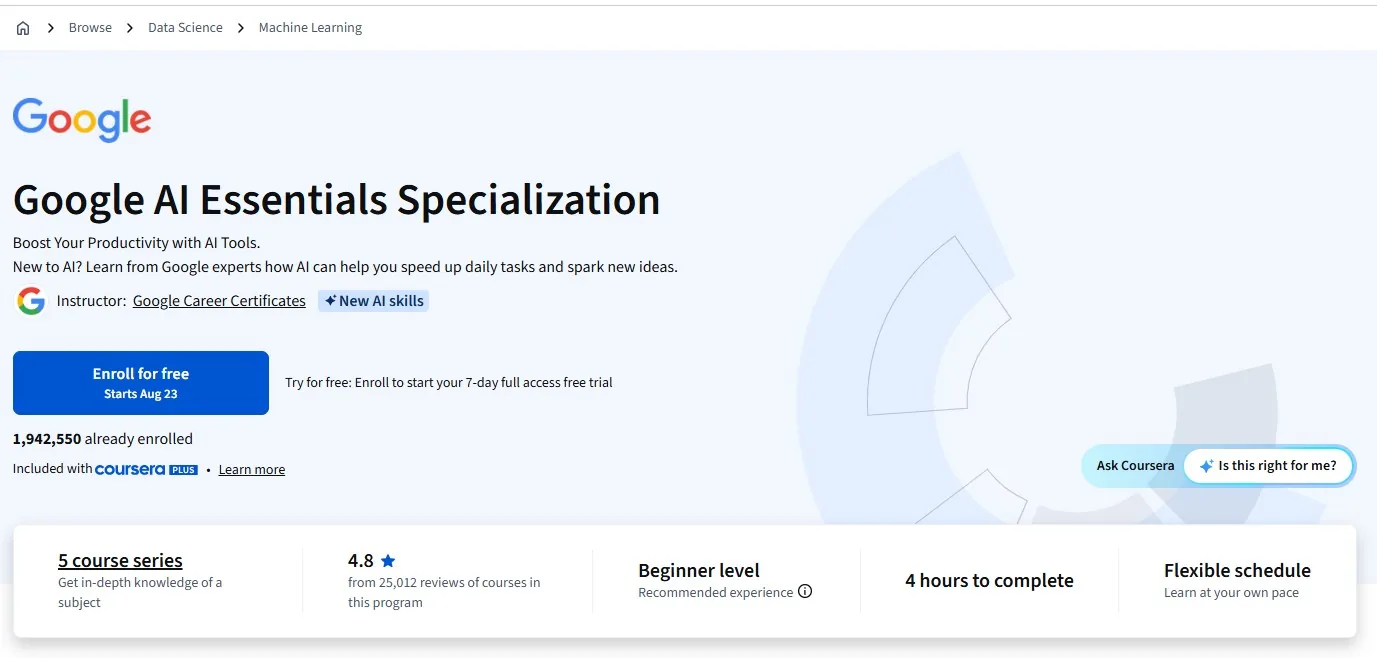
| Google AI Essentials | Google (Coursera) | Beginner | ~1–2 weeks part-time | No | Broad AI literacy beyond one tool | Coursera → |
| Elements of AI | University of Helsinki & MinnaLearn | Beginner | A few weeks part-time | No | Free, self-paced foundations | |
| Microsoft Learn AI modules (educator paths) | Microsoft | Beginner | Self-paced, hours per module | No | Schools running Microsoft 365 | |
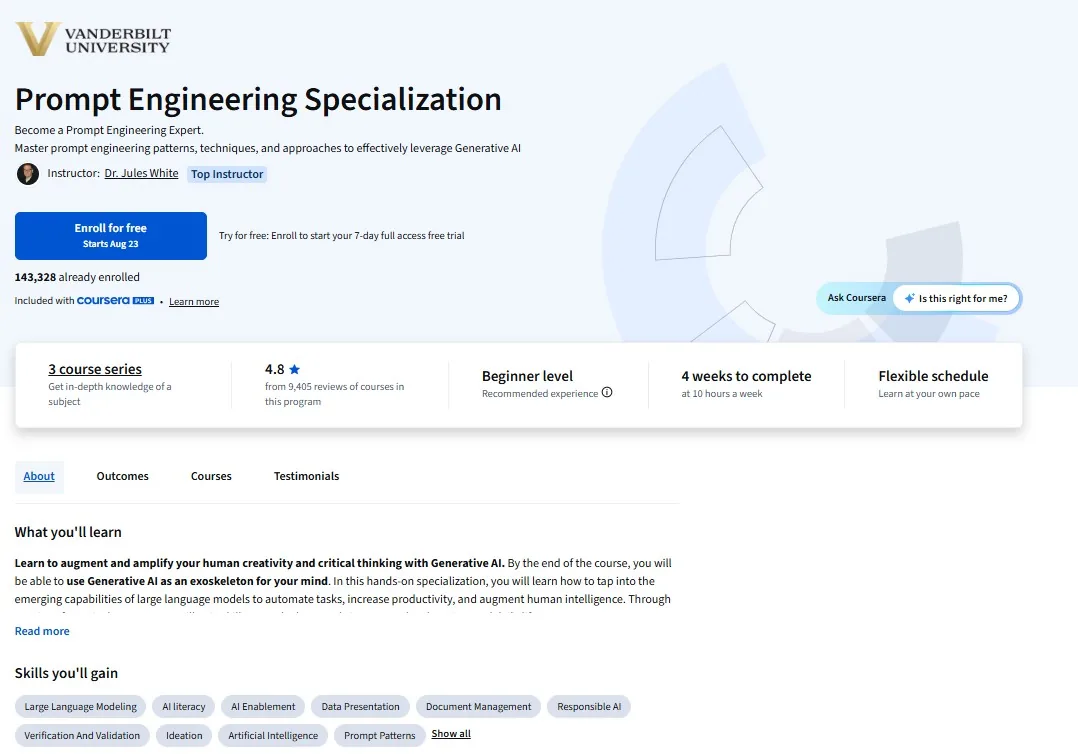
| Prompt Engineering Specialization | Vanderbilt (Coursera) | Beginner | ~39 hrs | No | Reusable lesson-planning prompt systems | Coursera → |
Do teachers need to learn to code to use AI?
No. Every certification worth a teacher's time is no-code, and any programme that starts with Python is solving a problem you don't have. Classroom AI work is prompting, judgment, and policy — writing better instructions to tools, spotting bad output, and deciding what's appropriate for students.
That has a useful consequence: your subject expertise transfers directly. A history teacher who can write a precise essay brief already has the core prompting skill; the certification's job is to add structure, vocabulary, and the failure modes — hallucinated citations, confident nonsense, bias in generated examples. If a course spends more time on how models are trained than on what to do when one invents a source, it was written for engineers and relabelled for educators. Our beginner's guide to AI certifications flags which programmes actually assume no technical background.
What's the best free AI training for teachers?
ChatGPT Foundations for Teachers is the headline option — designed for K-12 educators, free on Coursera, and short enough to finish in a planning week, though it issues no certificate. Elements of AI and Microsoft Learn's educator paths round out a genuinely free stack.
Elements of AI, from the University of Helsinki, is the most substantial free grounding in what AI actually is — useful if you want to answer student questions honestly rather than just operate a tool. Microsoft Learn matters most if your school runs Microsoft 365, because it covers Copilot in the tools you already teach with. The full list, including options that issue shareable certificates, is in our roundup of the best free AI certifications — and before you worry a free credential looks cheap, read our take on whether free AI certifications carry weight. For PD purposes, they generally do the job; nobody on a hiring committee is checking what you paid.
One caution: skip the pop-up "AI for educators" certificates from unknown sellers on course marketplaces. If the issuer isn't a name your principal would recognize, the certificate won't do anything a free one doesn't.
Not sure this is the right one for you?
Tell the picker about your background and what you want the certificate to do, and it narrows the list to the one or two courses we would start with. It suggests only our affiliate partners’ courses, and says so before it suggests anything.
Try the AI Certification Picker →Will an AI certificate count toward your professional development hours?
Sometimes — but the issuer can't promise it, because PD credit is decided by your district, state, or country, not by the course provider. Before you spend a weekend on any programme, send the syllabus to whoever approves your PD hours and ask in writing.
Some programmes market continuing-education alignment, and districts increasingly accept self-directed online PD — but acceptance varies wildly, and a certificate that counts in one district earns nothing across the county line. The practical move: pick the course on its merits first, treat PD credit as a bonus, and keep the completion certificate and syllabus PDF for your records either way. If the answer is no, the hours still weren't wasted — unlike most compliance PD, this one changes how you work on Monday.
Which certification fits your actual goal?
Match the course to the job you're doing, not the job the marketing imagines. There are three distinct teacher situations, and they point at different picks.
If you want to use AI in your classroom this term — lesson planning, differentiation, feedback drafts — take ChatGPT Foundations for Teachers, then add Vanderbilt's Prompt Engineering if you find yourself building the same prompts repeatedly. If you're the de facto AI lead for your school — writing guidance, running staff sessions — you need broader literacy than one tool: Google AI Essentials, cheaper if the fee is a barrier and your Coursera financial aid application is approved, plus enough genAI grounding to compare tools (our generative AI picks go deeper). And if you're pivoting out of the classroom toward instructional design or edtech, treat this like any career changer would: Google AI Essentials first, then follow the staged path in our AI certification roadmap rather than stacking teacher-branded badges that won't read outside education.
How should teachers handle student data with AI tools?
Rule one: never paste identifiable student information — names, grades, IEP details, behaviour notes — into a public AI chatbot. In US schools this territory is governed by FERPA, and most districts now have explicit AI policies; if yours does, that policy outranks anything a certification teaches.
A good teacher-focused course covers this directly: anonymizing before prompting, understanding what a tool does with input data, and knowing the difference between a consumer chatbot and a district-approved tool with a data agreement behind it. Treat privacy coverage as a quality filter when choosing a course — a programme that shows you twenty lesson-planning tricks but never mentions student data is teaching you to drive without mentioning brakes. This is also the topic to raise with leadership before an incident, not after; the teacher with a certificate and a working knowledge of the policy is usually the one asked to help write it.
What about OpenAI's new certification programme?
OpenAI has moved into certifications directly, and it matters for teachers because the education angle is central to how these credentials are being positioned. Whether it replaces ChatGPT Foundations for Teachers or sits alongside it is still settling — our full breakdown of the OpenAI certification programme tracks the current state.
The practical guidance for now: don't wait. A free, hours-long course you take this month beats a credential you monitor from a distance, and nothing about the foundations — prompting, judgment, data care — will be invalidated by whatever OpenAI ships next. If a formal OpenAI credential does become the recognized standard for educators, you'll finish it faster for having done the groundwork.
What comes after your first certificate?
Use it, visibly, within a month — that's what converts a certificate from a line on paper into professional capital. Redesign one unit's worth of lesson prep with AI assistance, document the before-and-after time cost, and share it at a staff meeting or in your department channel.
From there, two natural next steps. Inside school: volunteer for (or propose) the working group on AI guidance — certified staff who've actually shipped a classroom use-case are exactly who these groups lack. Beyond school: if the work energizes you more than the classroom does, that's a signal worth taking seriously; instructional design and edtech teams actively value teachers who can bridge pedagogy and AI tooling. Either way, resist the urge to immediately stack a second beginner certificate. One credential plus visible practice beats three badges nobody asked about.
Where most teacher AI training goes wrong
Most of it teaches tool tricks and dodges the hard questions. Fifty ways to generate a worksheet; nothing on what to do when your marking rubric meets an essay ChatGPT wrote. In our view, a teacher AI certification that doesn't address assessment redesign and academic integrity head-on is half a course — because that's the part of the job AI actually destabilized.
Our position: judgment beats features. Tools will churn — the interface you certify on this year will look different next year — but knowing when AI output is pedagogically useless, when a student's work isn't theirs, and when to keep AI out of a task entirely doesn't expire. Pick courses weighted toward judgment, and be suspicious of any programme, paid or free, whose syllabus reads like a product tour. This is also why vendor-neutral literacy (Elements of AI, Google AI Essentials) belongs in your stack even after a tool-specific course: the teachers navigating this well — the ones students actually learn honest AI habits from (our students guide covers the other side of the desk) — understand the category, not just one product.
Verdict
Take ChatGPT Foundations for Teachers first — it's the fastest useful training for a working teacher, and it is free on Coursera, so the cost is hours, not money. It awards no certificate, so if your district wants a completion record, pair it with a course that issues one. If you're your school's AI point person, or you're eyeing a move beyond the classroom, Google AI Essentials is the better foundation; whether any of it is worth your scarce time is a fair question, and our honest answer is: for teachers right now, the free tier almost always is. Confirm PD credit with your district before you start, not after. Still torn between picks? Our free AI certification Picker sorts it in about a minute.
Certifications featured in this guide
Every option below is one we cover in depth. Each link goes to the provider’s own page; where we’ve published a full review, read that first.
If you want to understand it, not just use it
The options above are about using AI in the classroom. DataCamp's AI Fundamentals track, in the table above, is about what is happening underneath — how models are trained, what the terms mean, where the ethical problems sit. Nine hours, no coding, and it is the one that makes you the person in the staffroom who can answer the question.
Ready to start?
Included in a DataCamp subscription rather than bought outright. DataCamp's pricing page shows the plans and the price for your country, and one subscription covers the rest of its catalogue too.
Frequently asked questions
Is there a free AI certification for teachers?
Yes. Elements of AI is free end to end including its certificate, and Microsoft Learn's educator modules are free with no payment step. ChatGPT Foundations for Teachers is free too and aimed squarely at K-12 educators, but it awards no certificate. Coursera courses like Google AI Essentials can also cost teachers less through Coursera's financial aid application.
Financial aid is the option most teachers do not know exists, so it is worth being specific: it is a form on the course page, it asks about your circumstances and what you intend to do with the certificate, and Coursera asks you to allow up to 16 days for a decision. Aid is granted per course, so Google AI Essentials — now a five-course Specialization — takes five applications, made one at a time — Coursera says you can apply for the next course once you complete each one; our financial aid guide walks through it. Teachers are exactly the applicant profile it was built for. If you want the recognised certificate rather than only the learning, apply before paying — our free certifications guide covers the fully free routes alongside it.
Is there a ChatGPT certification for teachers?
Not a certification as such. ChatGPT Foundations for Teachers, created by OpenAI with Common Sense Media, is free on Coursera and covers classroom ChatGPT use for educators, but Coursera’s FAQ says no certificate or credential is awarded for it, although its final module mentions a “Virtual Teacher Certificate”. OpenAI Academy, free to anyone with a ChatGPT account, now runs an educators’ learning path that includes a 45-minute AI for Educators course, and completing an Academy course and passing its assessment earns a free OpenAI Academy course badge — the nearest thing to a ChatGPT certificate a teacher can get today.
The Common Sense Media involvement is the part worth weighing. It means the Coursera course was built with media-literacy and child-safety people in the room rather than by a vendor alone, which shows up in how much of it is about protecting student data, keeping a human in the loop and being transparent about AI use. That emphasis is the reason to take the Coursera course first even though it is short. Our OpenAI certification guide covers how OpenAI’s Academy badges differ from its invite-only OpenAI Certification.
Do teachers need to know coding for AI certifications?
No. Every mainstream teacher-relevant option — ChatGPT Foundations for Teachers, Google AI Essentials, Elements of AI, Microsoft Learn — is fully no-code. Coding only enters the picture if you're pivoting into technical edtech roles, and even then it's a later step, not a prerequisite for getting started.
The skill that actually matters in a classroom is not technical at all: it is being able to tell when an output is wrong. Teachers are unusually good at this in their own subject and unusually exposed outside it, which is why the useful practice is to prompt something you could mark yourself and see what comes back. A model that invents a plausible date in a history summary is the whole lesson, and you cannot learn it from a syllabus.
Does an AI certificate count for teacher professional development credit?
It depends entirely on your district or state — the provider can't grant PD credit on its own. Some programmes supply completion documentation that approvers accept; many don't. Email your PD coordinator with the syllabus before starting, and keep your completion certificate regardless of the answer.
Ask for the approval in writing and ask before you enrol, in that order. Coordinators frequently approve things they have never seen when the request arrives with a syllabus, stated hours and a sentence about classroom relevance attached — and frequently decline the same course after the fact, because retroactive approval is a harder favour to grant. The email costs five minutes and decides whether the hours count, which is a good return for five minutes.
How long does AI training for teachers take?
The teacher-specific options are short: ChatGPT Foundations for Teachers runs hours, not weeks. Google AI Essentials is about six to ten hours of content, realistically one to two weeks at a few hours a week, and Elements of AI spans a few self-paced weeks. All fit around a teaching schedule.
Term time is the real constraint rather than the hour count, so plan around it honestly. These courses have no deadlines, which sounds ideal and is how most half-finished enrolments happen — a fortnight of marking swallows the momentum and the thread is gone. Two forty-minute sessions a week beats one hopeful weekend, and a holiday week is enough to finish any of the shorter options outright.
Keeping this current. Course formats, prices, and certification exam fees change and vary by region. We review our guides regularly, and we always recommend confirming the specifics on the provider's official page before you enrol.