We earn a commission if you buy through links on this page. How we're funded.
Quick answer
The fastest legitimate AI credentials, in order: an IBM SkillsBuild AI badge can be earned in an afternoon, Generative AI for Everyone fits in one focused weekend, and Google AI Essentials compresses into about a week of concentrated effort. All three are real, recognised and listable. Be clear about what speed buys, though: a fast certification proves literacy and initiative, not expertise — and anything promising an 'instant' certificate without real coursework is a mill that recruiters discount on sight.
See Generative AI for Everyone on Coursera →
The table below compares 6 certifications on provider, level, realistic time, coding needed and best for.
| Certification | Provider | Level | Realistic time | Coding needed | Best for | Enrol |
|---|---|---|---|---|---|---|
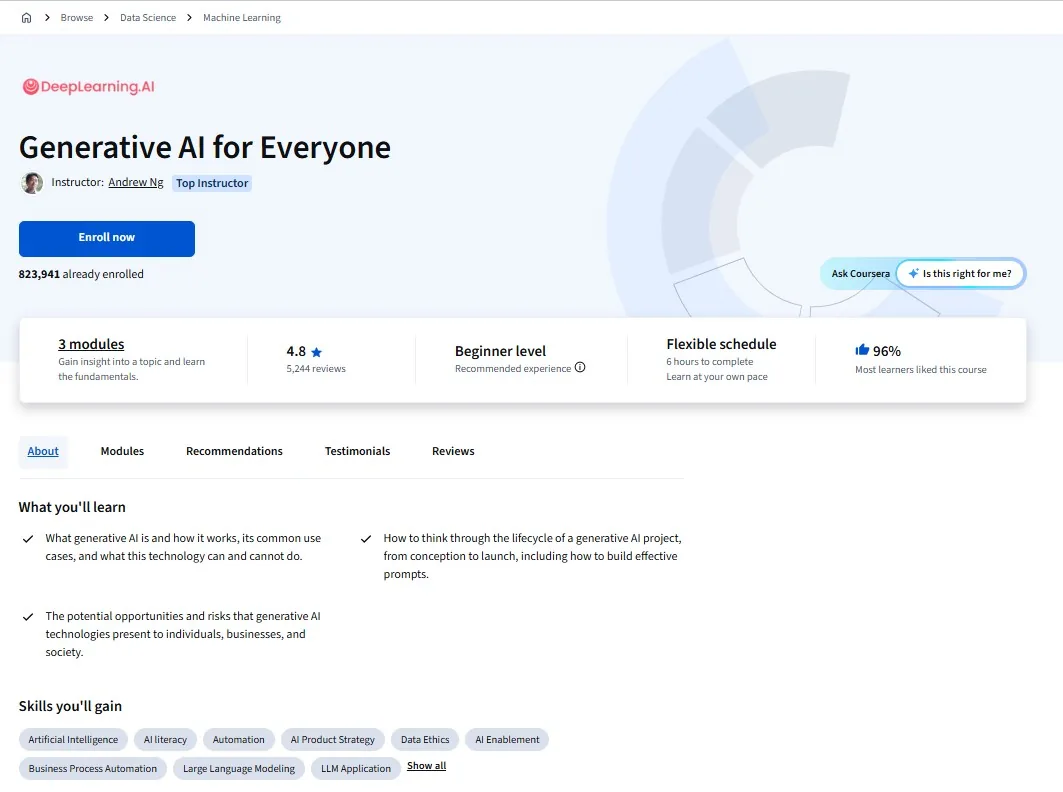
| Generative AI for Everyone | DeepLearning.AI (Coursera) | Beginner | A focused weekend | No | The fastest substantial course | Coursera → |
| IBM SkillsBuild AI credentials | IBM | Beginner | Hours to a day | No | The fastest listable badge | |
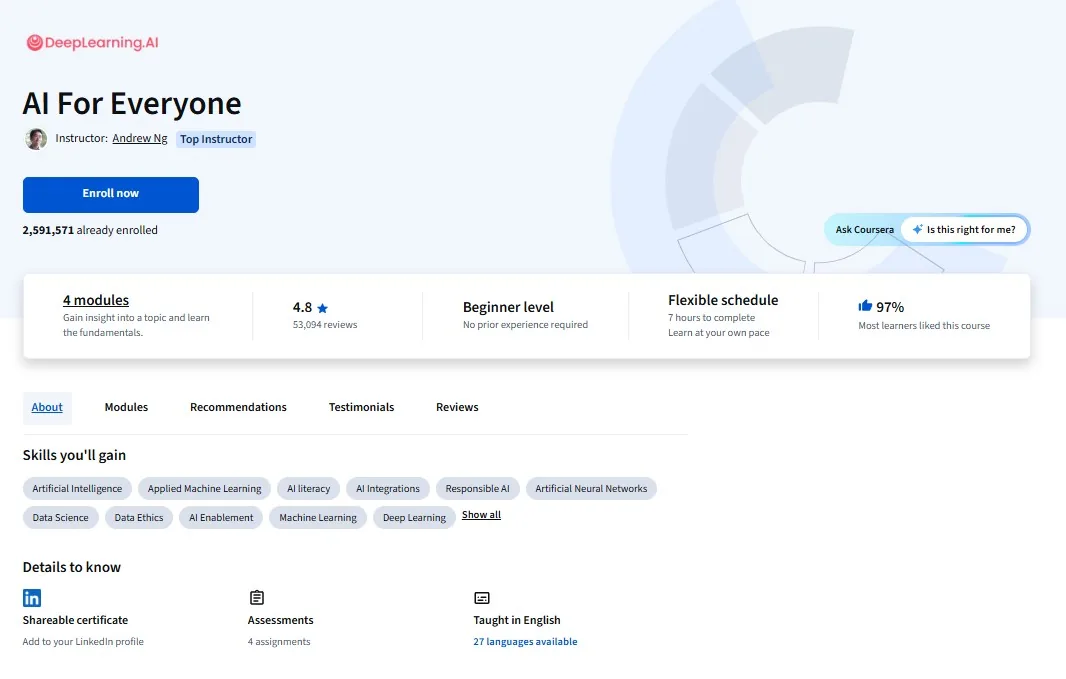
| AI For Everyone | DeepLearning.AI (Coursera) | Beginner | A focused weekend | No | Quick strategy-level overview | Coursera → |
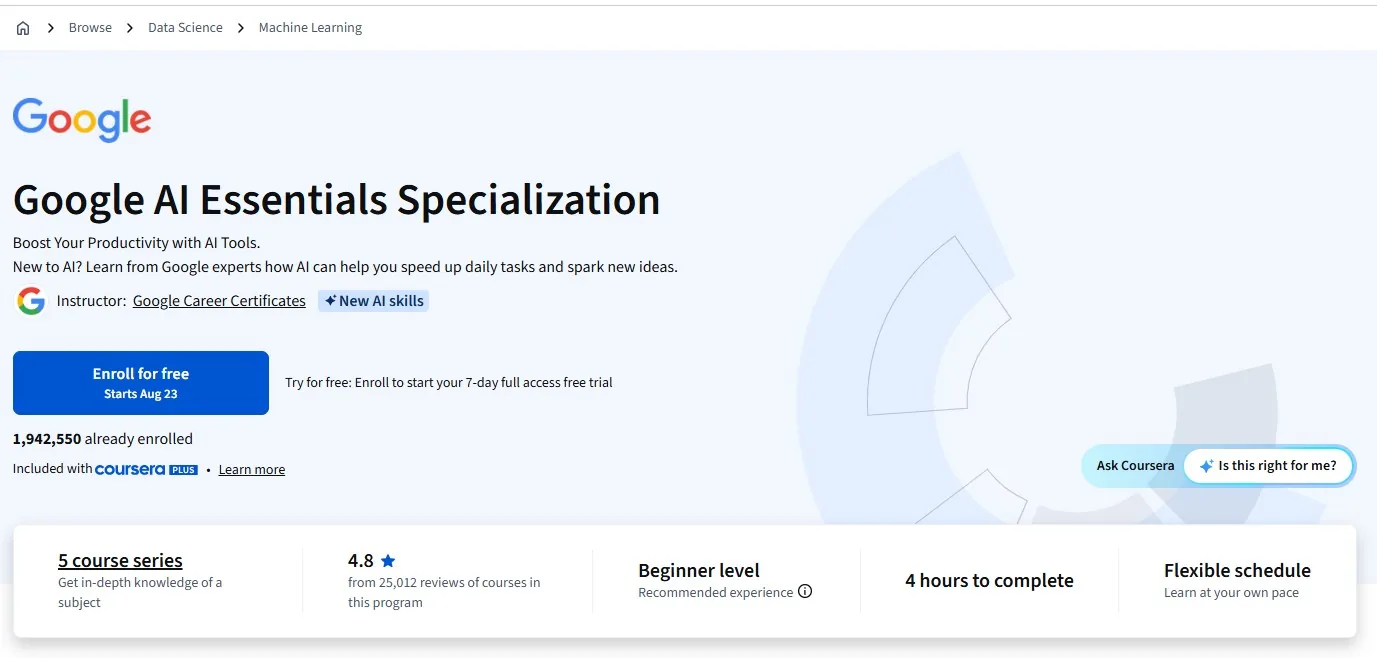
| Google AI Essentials | Google (Coursera) | Beginner | 4–8 hrs | No | The fastest course with strong name recognition | Coursera → |
| Elements of AI | University of Helsinki & MinnaLearn | Beginner | ~24–48 hours (six parts) | No | Fast, free and widely respected | |
| Azure AI Fundamentals (AI-901) | Microsoft | Foundational | Varies with Python experience | Basic Python | The fastest proctored exam credential, if you already know basic Python |
What's the fastest legitimate AI certification?
An IBM SkillsBuild AI badge — free, earnable in an afternoon, and issued by a name recruiters recognise. For something with more substance behind it, Generative AI for Everyone from DeepLearning.AI is the fastest real course: a few hours of video and exercises that a focused weekend covers comfortably. If you want the strongest brand per hour invested, Google AI Essentials at roughly a week of concentrated effort is the sweet spot — our full review breaks down what the modules cover.
Draw the line at legitimacy. 'Fast' should mean a genuine curriculum compressed by your effort, not a certificate mill that issues a PDF for an email address. Recruiters have seen both, and they can tell — a credential from a provider nobody has heard of, earned in an hour, signals the opposite of what you want. Every option in the table above is real coursework from a recognised issuer; our beginners' guide sequences them if you decide to go past the quick win.
What can you genuinely finish in a weekend?
Three things, honestly: a SkillsBuild badge on Friday evening, Generative AI for Everyone across Saturday and Sunday, or AI For Everyone in the same window. A realistic weekend plan:
- Friday evening: create your accounts, claim the SkillsBuild AI badge, and set up the weekend's course so Saturday starts at lesson one, not at a signup form.
- Saturday: work through Generative AI for Everyone's core modules — a few hours in the morning, a break, and the exercises in the afternoon. Do the exercises; skipping them is how weekend courses evaporate by Wednesday.
- Sunday: finish the remaining modules, take the assessments, and spend the final hour applying one workflow to your actual job — draft Monday's emails, summarise a report, build one reusable prompt.
What does not fit in a weekend: Google AI Essentials (possible in a long week, not two days), any specialization, and any proctored exam you have not prepared for. Claiming otherwise would be the kind of promise this site exists to filter out.
Which fast credential signals the most?
Speed and signal are different axes, and the ranking flips depending on the reader. Ordered by what they communicate to an employer:
- Proctored exams (Azure AI Fundamentals, now exam AI-901) carry the most weight per hour — an independently verified pass, not a completion certificate. Since AI-901 replaced AI-900 on 30 June 2026 it expects basic Python syntax, so it is only fast for readers who already have some.
- Brand-name course certificates (Google AI Essentials, DeepLearning.AI courses) come next — the issuer's name does the talking at CV-skim speed.
- Badges (IBM SkillsBuild) prove initiative and freshness. Useful as a same-week signal, weakest as a standalone credential — our analysis of whether free certificates carry weight covers exactly how recruiters read them.
Exam AI-900: Microsoft Azure AI Fundamentals is retired. The replacement is Exam AI-901: Microsoft Azure AI Fundamentals, which earns the same Azure AI Fundamentals certification but expects Python and familiarity with REST APIs and SDKs.
The practical play for most readers: badge now, brand course this week, and decide later whether an exam is worth it for your role.
When is fast the right call?
Fast is correct when there is a date attached. The legitimate cases:
- An interview this week where the job description mentions AI — a completed credential plus one concrete usage example beats vague enthusiasm.
- A performance review or promotion case where 'developing AI skills' needs evidence behind it by Friday.
- A proposal or client meeting where you need working vocabulary fast — capability boundaries, hallucination, where costs live.
- Your company just announced an AI rollout and you want to be visibly ahead of the training calendar rather than behind it.
In every case the certificate is the receipt, not the point: pair it with one applied example from your own work and it holds up under questioning. Alone, it does not.
What does speed cost you?
Retention, mostly. A weekend of compressed video produces a certificate and a fog — fast-consumed content tends to fade within days unless it is used immediately. The fix is cheap: within one week of finishing, rebuild one real task from your job with what you learned, and do it three times. The credential gets you past the skim; the retained workflow is what survives a follow-up question.
The other cost is depth you may not need yet. A fast course covers what AI does and how to drive it — not how models work, not evaluation, not building anything. That is fine for literacy. It becomes a problem only if you present a weekend certificate as more than it is; calibrate the claim to the credential and nobody is embarrassed.
Not sure this is the right one for you?
Tell the picker about your background and what you want the certificate to do, and it narrows the list to the one or two courses we would start with. It suggests only our affiliate partners’ courses, and says so before it suggests anything.
Try the AI Certification Picker →What are the fastest free options?
The fastest path costs nothing at all. IBM SkillsBuild badges are free and same-day. Elements of AI is free with a certificate of completion and moves quickly if you push. Most Coursera courses open their first module free, and select ones offer every module free without a certificate; Microsoft's practice assessment for Azure AI Fundamentals (now exam AI-901) is free even though the exam itself is not. Our roundup of the best free AI certifications ranks the wider field if the budget is the constraint as much as the clock.
When should you slow down instead?
When there is no date and the goal is a capability. If you are aiming at a technical role, a portfolio, or genuine depth in generative AI — the systematic stacks in our generative AI guide — speed is the wrong axis entirely, and a sustainable pace finishes what a sprint abandons. Our five-hours-a-week plan is built for exactly that: steady part-time progress that survives a full-time job.
Also slow down if this is your second fast certificate. One quick credential is a signal; a row of weekend badges with no applied work between them reads as collecting, and our analysis of whether AI certifications are worth it is blunt about how thin that looks.
Where speed-run advice gets it wrong
Most 'fastest certification' content treats the certificate as the finish line. Here is the problem: the certificate takes a weekend, and the interview follow-up question takes ninety seconds. 'I see you did an AI course — how have you used it?' is now a standard probe, and a speed-runner with no applied example fails it in front of the person they got the certificate to impress. The credential opens the door to a question only practice can answer.
Our position: fast certifications are openings, not strategies. The weekend course is genuinely valuable when it starts something — a workflow you keep using, a follow-on course at a saner pace, a visible contribution when your company rolls out AI. It is worthless as a terminal move, and the certificate-mill economy that sells 'instant AI certification' is worse than worthless: it attaches your name to an issuer that signals gullibility. Spend the weekend on a real course from a real provider, then spend the following week using what it taught you. That sequence — not the speed — is what changes anything.
Verdict
If you need something listable this week: claim an IBM SkillsBuild badge today, finish Generative AI for Everyone over the weekend, and apply one workflow to your job on Monday. If you have a week and want the strongest name, Google AI Essentials is the better spend of the same energy; Google's AI Professional Certificate, at 8 to 13 hours by Coursera's own figures, is the stronger course by our scores but the slower one to finish. If your deadline is real but your goal is bigger than the deadline, do the weekend course now and then switch to the staged path in our AI certification roadmap — or describe your situation in a sentence to our free Picker tool and get the sequence matched to your situation.
Certifications featured in this guide
Every option below is one we cover in depth. Each link goes to the provider’s own page; where we’ve published a full review, read that first.
The fastest paid option we would actually name
The options above are the fastest recognised credentials. If the constraint is purely time — you want to understand the field by the end of an evening and you do not need anyone to be impressed — the shortest thing on this page is two and a half hours, and it is not a certification at all.
We picked it out of the six most-reviewed Udemy AI courses whose pages we read in full on 26 August 2026, and it was the only short one whose promises matched its length: six stated outcomes, all of them plausible in two and a half hours. One of the six we rejected claims to cover Bayesian models, VAEs, GANs and transformers in one hour thirty-nine minutes, and holds a 4.4 rating from over forty thousand people while doing it. That is the trap on this particular page: the shortest listing is not the fastest route to competence, it is usually just the emptiest, and a high rating does not distinguish the two.
Its price depends entirely on the day. On 26 August 2026 it showed $9.99 — the same $9.99 every other Udemy AI course showed, under a different struck-through price and an identical one-day countdown. On 28 August there was no sale at all and it was back at full list. Check before you buy. It issues a certificate of completion that carries no employer recognition, which is one of the six factors we score and the reason it sits here rather than in the ranking above. Six courses checked logged-out on 26 August 2026 and again on 28 August 2026, prices in USD.
Ready to start?
Paid through Coursera rather than through the provider, and not included in Coursera Plus. Coursera prices it by country.
Frequently asked questions
Can I get an AI certification in a weekend?
Yes, legitimately — as long as you pick something genuinely sized for a weekend rather than rushing something that is not. Generative AI for Everyone and AI For Everyone, both from DeepLearning.AI, each fit into a focused weekend at roughly six and seven hours respectively. An IBM SkillsBuild AI badge takes an afternoon. Those are real completions, not shortcuts.
What does not fit is anything larger, and it is worth being clear about which is which. Google AI Essentials is a five-course Specialization and needs a week of real effort; any multi-course specialisation runs to months; and a proctored vendor exam needs preparation time regardless of how quickly you can read the syllabus. Compressing one of those into two days produces a certificate you cannot speak to in an interview, which is worse than not having it.
What is the fastest free AI certification?
An IBM SkillsBuild AI badge is the quickest — free, and earnable in a single day. If you want the fastest free option with real substance behind it rather than the fastest full stop, Elements of AI is the better answer: 24 to 48 hours across its six parts by the provider's own estimate, no cost, and a certificate of completion from a respected university programme rather than a vendor.
Two other routes are worth knowing about, because they change what free means. Select Coursera courses offer a free "Full Course, No Certificate" option — every lesson and graded assessment, but no certificate — and most at least let you preview the first module, which is fine if you want the knowledge and not the credential. And Coursera runs a financial aid programme that takes a discount off a course's fee if your application is approved, with a wait of up to sixteen days. Our free certifications guide compares all of these properly.
How fast can I pass the Azure AI Fundamentals exam?
Its exam is now AI-901, which replaced AI-900 on 30 June 2026 and, unlike AI-900, expects knowledge of Python syntax, so how fast you can prepare depends first on whether you already write some Python. Microsoft offers a free practice assessment; use it to judge your readiness before you book.
One practical point that catches people out: the exam fee applies whether you pass or fail, and whether you prepared for one week or five. That asymmetry should shape the date you book. Book far enough out that your preparation is honest, then sit it — an unbooked exam drifts indefinitely, and a booked one you are not ready for costs you the fee twice. AI-901 is a genuine proctored exam rather than a course-completion certificate, which is exactly why it carries more weight.
Does a fast AI certificate actually help a job application?
It helps at the screening stage and stops helping shortly afterwards, which is a real but narrow benefit worth understanding precisely. A recognisable name — Google, Microsoft, DeepLearning.AI — survives the six-second skim that decides whether a CV is read at all. That is genuinely valuable, and it is the whole of what a fast credential buys you.
It stops helping the moment an interviewer asks how you have actually used it. At that point the certificate is worth nothing and the example is worth everything, so pair any fast credential with one concrete thing you changed at work because of it before you rely on it in an application. The failure mode to avoid is collecting several fast certificates instead of one plus a worked example — a list of five literacy badges reads as activity rather than capability.
What should I do after a quick certification?
Use it within a week, or you will lose most of it. The specific method that works: pick one real task from your actual job, rebuild it using what you just learned, and do that three times. Repetition on real work is what moves a course from something you watched to something you can do, and a week is about how long the material stays fresh enough to make that easy.
Then make a deliberate decision rather than drifting. If literacy was the goal — you wanted to use AI tools competently and explain their limits — stop there, and spend the time you would have spent on a second badge building something instead. If you want the deeper credential your role actually rewards, start it at a sustainable part-time pace rather than another sprint. Our certification roadmap lays out what follows what.
Keeping this current. Course formats, prices, and certification exam fees change and vary by region. We review our guides regularly, and we always recommend confirming the specifics on the provider's official page before you enrol.